I marched with the James Reeb Unitarian Universalist Congregation and other UUs in this part of Wisconsin as part of what might be the largest demonstration in Wisconsin history.
Please click on the picture above for a better view of the photos and videos in this slideshow, and to read the full captions.
Estimates are 100,000 outdoors and another 4000 inside the Capitol building.
It was a strange combination: such a peaceful environment, yet so much anger being expressed. Good feelings, yet with an intensely somber, sober purpose.
The newly elected governor of the state has set to the task of dismantling the middle class in Wisconsin. The tactic is to pit people against one another. Divide and conquer. Yet a broad range of people come together in this common purpose.
Showing posts with label James Reeb Unitarian Univsalist Congregation. Show all posts
Showing posts with label James Reeb Unitarian Univsalist Congregation. Show all posts
Sunday, February 27, 2011


Sunday, October 3, 2010
String Theory and Theology
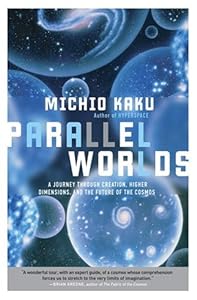 Cover via Amazon
 Today I was a worship associate for a service at the James Reeb Unitarian Universalist Congregation for the second time. The topic was "String Theory and Theology."
I researched and read all I could over the course of about a week and a half. Several days in, I realized I wasn't going to understand string theory well enough to write anything about it in time to make a presentation by the end of the week! So I decided to do readings instead.
The book I studied most was Parallel Worlds by Michio Kaku. Donald and I bought a book of his called Hyperspace in the early 1990s when we belonged, briefly, to the Book of the Month Club. We never read it. It looked really cool. We were too intimated by it, I guess, to ever actually crack it and start reading. From what I could see of Parallel Worlds, published in 2005, it seemed to update a lot of stuff from Hyperspace. So I figured that I owed it to the guy to at least read one of his books, considering that I had waited so long on the other one that it might already be obsolete!
Chalice lighting
 Image via WikipediaOur opening words come from the physicist and cosmologist George Gamow, born in 1904 in Odessa, Russia, who attempted to escape the Soviet Union by sailing to Turkey on a raft and went on to become one of the originators of the big bang theory of the origin of the universe, which he heroically defended against ridicule for years before it became generally accepted.
Gamow wrote this poem:
There was a young fellow from Trinity
Who took the square root of infinity
But the number of digits
Gave him the fidgets;
He dropped Math and took up Divinity.
Pastoral Thought: "Cosmic Music"
 Image via WikipediaThe reading is excerpted, abridged and somewhat rearranged from Parallel Worlds: A Journey through creation, higher dimensions and the future of the cosmos, by theoretical physicist Michio Kaku.
The link between music and science was forged as early as the fifth century B.C., when the Greek Pythagoreans discovered the laws of harmony and reduced them to mathematics. They found that the tone of a plucked lyre string corresponded to its length. If one doubled the length of the string, the note went down one octave. If the length of a string was reduced by two-thirds, the tone went up a fifth. Hence the laws of music and harmony could be reduced to precise relations between numbers. “All things are numbers,” they said.
They dared to apply these laws of harmony to the entire universe. They failed because of the enormous complexity of matter.
In some sense, with string theory, physicists are going back to the Pythagorean dream.
According to string theory, if you had a supermicroscope and could peer into the heart of an electron, you would see not a point particle but a vibrating string. If we were to pluck this string, the vibration would change; the electron might turn into a neutrino. Pluck it again and it might turn into a quark. In fact, if you plucked it hard enough, it could turn into any of the known sub-atomic particles.
On a violin string, we can generate all the notes of the musical scale. B flat is not more fundamental than G. In the same way, electrons and quarks are not fundamental – the string is. All the subparticles of the universe can be viewed as nothing but different vibrations of the string.
The “harmonies” of the string are the laws of physics.
The lowest vibration of the string can be interpreted as the graviton, the point particle of gravity.
As the string moves and breaks and reforms, we find Einstein’s theory of general relativity.
If Einstein had never discovered relativity, it might have been discovered as a by-product of string theory.
Music provides the metaphor for the nature of the universe, both at the subatomic level and at the cosmic level.
Einstein said his search for a unified field theory would ultimately allow him to “read the Mind of God.” If string theory is correct, we now see that the Mind of God represents cosmic music resonating through ten-dimensional hyperspace.
Closing words
Our closing words are from the philosopher Giordano Bruno, burned to death 1600 for refusing to renounce views such as this.
“Thus is the excellence of God magnified and the greatness of his kingdom made manifest; he is glorified not in one, but in countless suns; not in a single earth, a single world, but in a thousand thousand, I say in an infinity of worlds.”

Sunday, September 19, 2010
Enough, already!
 Image via Wikipedia
I gave this talk at James Reeb Unitarian Universalist Congregation as the Pastoral Thought for the worship service titled "Spiritual Harvests: Accepting your highest good." Maison Cruz was the lead presenter. Bryan Verstegen provided music.
Good morning, good morning, good morning!
(Quieting response from congregation) Alright, that’s enough.
(Sternly) I said that’s enough.
(Hands on hips) I’ve had just about enough.
(Nonchalantly) Well! That’s enough of that!
“Enough”: I thought that was a good thing.
In fact, I’ve heard it said that you can’t have too much of a good thing.
It should follow, logically, that “enough” can’t ever be a bad thing.
So how much is enough? Is “enough” a “how much”? Is it an amount at all?
Or is it a state of mind?
I know I don’t make enough money. I think. But what does that mean?
I have enough to eat. I have a place to live. Heat in the winter. Clean water. Shoes. I have a little boy. And that means I have enough to worry about. But I’ve never worried that maybe he might starve.
But I don’t have enough to buy a house. Or visit Spain. Or even my own hometown.
So naturally it seems to me that I’d be happier if had more. It’s like, I have enough. But I don’t have enough.
But enough still is better than not enough. That’s simple enough.
Or is it?
 Image via Wikipedia
Conveniently for me.
Ellison gives his take of the miracle of the loaves and the fishes:
[The disciples] looked at each other, and they looked at him and said, that’s not enough to feed all of these people. It’s not enough. They’ve got to go home. We can’t help them out…
And Jesus, he didn’t argue with them. He just started handing out food, and as the scripture goes, there was enough. There was enough … [T]he scripture says that after the meal, there was not just enough. There was more than enough, and they had to pick up what was left over.
Then Ellison suggests some ideas for what might have actually happened. He says he doesn’t know, but he seems to favor this one:
[M]aybe what happened is that the disciples’ perception of scarcity was misinformed and actually there was more than they understood there to be. Maybe there was abundance. Maybe there was radical abundance, though they saw scarcity.
Like the villiagers in the telling of “Stone Soup” we just heard, Ellison thinks maybe the disciples were looking at something that was actually enough, but their fear, their scarcity consciousness made them see it as not enough.
He goes on to make his larger point:
And you know, today, there’s enough. There’s enough for you and for me. There’s enough for the straight and the gay. …. We don’t have to throw anybody under the bus. We don’t have to chase anybody out the door...
There’s enough. Right? But you know what? There may not be enough if we continue to spend more than any other nation on the military. …
There may not be enough if there’s greed, if there’s hoarding. There may not be enough if we take the bountiful oceans that we’ve been blessed with and we pollute them with fossil fuels that spill into our oceans. …
There’s enough. Right? But you know what? There may not be enough if we continue to spend more than any other nation on the military. …
There may not be enough if there’s greed, if there’s hoarding. There may not be enough if we take the bountiful oceans that we’ve been blessed with and we pollute them with fossil fuels that spill into our oceans. …
You know there may not be enough if we squander and waste what we have. There may not be enough if we devote all of our resources to war-making and killing and destruction. But there is enough, brothers and sisters, if we will embrace love….
Ellison’s assumption here is that “enough” is a good thing. We need to realize that we have enough, we have plenty, and not squander it and destroy it, because then we would have “not enough,” and “not enough” is a bad thing. That’s the assumption this reasoning is based on. That “enough” is a good thing.
But I wonder. Whether having enough might actually be the problem. A problem that it is very, very difficult for the human animal to overcome.
 Image via WikipediaIn his book “Guns, Germs, and Steel” author Jared Diamond describes how inequity has come about in human societies. And how it has come to be the dominant pattern on earth.
It seems that whenever, wherever there’s not quite enough, people figure out how to share. How to get by. How to get along. But wherever there’s plenty – wherever there’s enough – there’s poverty. It’s a tragic paradox, but it tracks around the globe and through history.
For instance, wherever grain is cultivated – the Fertile Crescent, China, Mesoamerica, South America, the places where food production was independently developed – chieftains arise, and then kings. Right away, society splits into strata. Hierarchies.
Why? Why kings and grain? Why does grain mean kings?
It’s food that lasts long enough to store. It’s food that you can grow enough of to store. Stored in places. Places that can be controlled.
Now, right away, there are people with more, and people with less.
There’s so much food that not everyone has to spend their days hunting it and gathering it. Now some people can devote themselves to other things: and now there can be artisans. Stonemasons. Smiths. Scribes. Priests. Soldiers.
Soldiers who can go out and get more territory to grow more food, and bring back slaves from those places. Slaves that can do the menial tasks that by now there’s technology to do. Like, slaves can build temples to communicate the message about following the king and listening to the priests to fulfill your role in producing the food – and by now all the other technologies – that make the society run that controls the flow and distribution of food. And all the other stuff. Stuff that you now need to live in that society.
In this book, Diamond describes the Polynesian Islands, thouands of islands in the Pacific, with all different climates and conditions – how the toughest islands to live on were the most egalitarian, with sophisticated systems for conflict resolution.
In the subarctic Chatham Islands, for instance, the soil wasn’t rich enough for farming, so the Polynesian settlers had to revert to hunting and gathering. There was never quite enough for the population to grow, so they learned to keep one another going. They couldn’t kill each other; there weren’t enough people to spare. They had to learn to get along.
While in Hawaii, the soil was rich enough and there were enough inland streams for irrigation and the sun was warm enough to grow plenty of crops. There was building stone for sturdy dwellings and aquaculture to farm enough fish for plenty of protein. A tropical island paradise, right? Enough of everything! Plenty!
But here was despotism. Empire. Incessant and ferocious war. All this plenty was only for the kings and the ruling classes and the priests. Rations and bloodshed for everybody else.
In America’s Great Depression, when so many people didn’t have enough, in reality there was plenty. Plenty of wheat. Plenty of coal. Plenty of money! And you can’t have too much of a good thing, right? Unless it’s not where it needs to be.
And it seems that when we humans have enough, or more than enough, somebody gets control of it, and those people just won’t let it go, voluntarily.
I guess because they feel like if they do, they just won’t have enough.
Which brings us back to “enough” being a state of mind.
Today our corporate executives with multimillion dollar golden parachutes clearly don’t feel that a few hundred thousand dollars a year is enough. They need their income in the millions. But for them to have that, everybody else needs to have less. Less pay, less insurance, less time off. All those ridiculous expenses, those unreasonable perks, that are forcing them to place jobs overseas where people are happy – desperate! – to see them come, because they don’t demand so much. People who have a lower expectation of “enough.”
What does it all mean? What does it all add up to?
I would go on.
(Looks at watch) But I don’t have enough time.
Thank you.

Sunday, September 13, 2009
Indian Lake Hike with Reeb UU Congregation
We loaded up a few carpools and headed west to Indian Lake Park. Click on the picture to view a slideshow.
Saturday, September 12, 2009
Indian Lake 2

Sarah Elmore organized the trip. Everyone had a great time. Lexander found a stand of rare Indian Pipe flower. Angus found more nearby, and a trunk of tree ear mushroom.
 Ulysses and me in a log cabin in a clearing.
 We picnicked in the shelter after working up an appetite on the three mile hike!

Subscribe to:
Posts (Atom)