Showing posts with label family. Show all posts

Tuesday, February 16, 2010

Star Wars AT-AT Walker birthday cake


For weeks, Ulysses has been describing the cake he wanted for his sixth birthday party: a "Giant Robot Cake." All good Star Wars geeks will recognize this as an AT-AT Walker as seen in the Battle of Hoth, in the early scenes of The Empire Strikes Back.


After some slices were taken out, the head adopted a more lifelike angle!


The luscious cake interior. I assure you, no mixes were involved. Everything is completely from scratch.


I have to run to U's kindergarten party now to deliver 24 Storm Trooper cupcakes. I promise more details in this very post ASAP!

Friday, January 9, 2009

Dan i Noć (Day and Night Serbian bar cookies)

I've always loved the name of these cookies – "Dan i Noć" (pro nounced "DAHN ee NOCH,") translates as "Day and Night." They show their sense in such a forthright way. Day and night: a light layer and a dark layer. What could be more sensible? The layer of apricot jam between the day and the night makes sense, too: a shimmering sunset – or perhaps a sunrise – of transluscent orange.

These cookies – or little cakes, as you might consider them – are generous and rich. The recipe includes a pound of butter, a dozen eggs, darn close to a half pound of chocolate, a whole jar of apricot preserves. Speaking of which, I recommend spending the extra couple of bucks to get really good apricot preserves. Look for apricots as the first ingredient, and real sugar as opposed to high-fructose corn syrup or other sweeteners. (Fruit-only sweetened is good, too.) If you buy more than one jar and do a side-by-side taste test at home, you will see how big a difference it really makes.

I remember having these at the home of my aunt and uncle when we would visit around Christmastime. it was one of the sitni kolaći (little cookies) specialties of my Grandaunt Naka (b. 1913), whom I shared more about here. Like Naka's Vanil Grancle, these feature apricots, that grow so well around her native town of Kikinda.

My cousin tells me Naka got the the recipe from her best friend, also from Kikinda. The best friend's family helped Naka's family in some way during the Nazi occupation of Yugoslavia, but I don't know the story beyond that.

Here's Ulysses in January 2008 (nearly four years old in this picture) enjoying a piece of Dan i Noć.

Shortly after this photo was taken, that laptop stopped working. Turned out it was plugged up with cookie crumbs.

I'm posting this today as a hat tip to my niece, Anne (she is the daughter of my cousin, and by the Serbian way of looking at family relations, that makes her more of a niece to me than anything else), 7. She loves Dan i Noć, and was sad to discover there wasn't any at the family get-together in Baltimore this year. My cousin wrote, "She was really, really bummed when she heard that no one made dan i noc. I remembered telling her to choose either gitar [another exceptional sitni kolacic in the family, I'll post that recipe too] or dan i noc as her favorite and she chose gitar so that's what i made but it seems i may have forgotten to tell her why i was asking. she got tears in her eyes, made me so sad!

"so this weekend we're making dan i noc. that works because i wouldn't have had time to make it with her before Bozic [Serbian Christmas] this time and making it together is just as important as having it for Bozic!"

Here's Anne last year (she was Annie then) enjoying the Dan i Noć she made with her mother for Božić 2008.

Recipe: Dan i Noć

Filling
1 jar apricot preserves

Noć (Night)
2 sticks unsalted butter, at room temperature
1 cup sugar
6 medium eggs (or 5 large)
6 squares (or 6 ounces chips) semisweet baking chocolate (each square is one ounce)
1 teaspoon vanilla
1 cup flour
1 teaspoon baking powder

Dan (Day)
Same ingredients as the Noć, but without the chocolate:
2 sticks unsalted butter, at room temperature
1 cup sugar
6 medium eggs (or 5 large)
1 teaspoon vanilla
1 cup flour
1 teaspoon baking powder

1. Melt chocolate
Melt the chocolate. Use low heat and stir often, so the chocolate won't seize or scorch. Use a heavy-bottomed pan, a flame tamer, or a double boiler if you have one. By the time you add the chocolate to other ingredients, it should be liquidy, but cool enough that it won't cause the eggs to cook on contact.

2. Soft-bake the Noć
Cream butter and sugar. Beat in eggs one at a time. Stir in the chocolate and vanilla.

Whisk together flour and baking powder. Mix these dry ingredients into the wet mixture. This will make a soupy batter.

Line a rectangular baking pan with parchment paper or aluminum foil. No greasing is needed. Pour in the batter. Shake sideways, or rap the pan sharply against your counter, to knock out extra air bubbles. You can see in my photos that I missed this step – see what happen?

Bake at 350 for about 30 minutes. It needs to be firm enough that you can spread jam over it, but not baked through, That is, at this point a toothpick inserted in it will not come out anywhere near clean.

3. Prep the Dan
While the Noć is in the oven, prepare the batter for the Dan. Cream butter and sugar, beat in eggs one at a time, beat in vanilla, whisk together flour and baking powder, stir dry mix into wet mix.

4. Apply the jam layer
Remove from oven. Spread the apricot preserves evenly over the dark Noć layer while still warm.

5. Add the Dan layer
Carefully pour the light batter evenly overtop the contents of the pan.

6. Final bake
Put the pan back in the oven for another 30 minutes, or until a knife (or cake pick) inserted in the center comes out clean. The instructions I received say to check the Dan, but I found that the Noć took longer to bake through, so make sure your Dan and your Noć are baked throughout.

The Dan will be beautifully golden brown on top. If the Dan is as browned as it needs to be, but the cake inside still needs more baking, cover the pan tightly with foil (or place a cookie sheet over it) so the top won't overbake.

7. Cool and cut
Let cool. Carefully lift the whole cake from the pan and transfer to a large cutting surface. Slice into rectangular pieces about the width and length of your index finger. Cut carefully and methodically so that your pieces are evenly sized, with straight sides and square corners. I used the patterns on my wooden cutting board as my guides.


The finger-sized pieces are lovely and make hearty portions of this rich dessert. However, after a while I cut some of them into thirds, and found this size makes a wonderful bite-sized treat.

Wednesday, December 24, 2008

Christmas Eve 2008


I just reread this blog entry from last Christmas Eve – http://vesnavuynovich.blogspot.com/2007/12/adorable-christmas-anecdotes.html – and was struck by the magnitude of difference in Ulysses today: his comprehension, the abstraction of his thoughts, his articulation of them. Last year he was in the moment in such a way – there was no use describing to him a distant future.

This year he's been anticipating Santa's visit for weeks, announcing regularly that tonight was the night. We pointed to the day on the calendar as it approached, showing him, "We're here, this is today. Santa's coming on this day." It was hard to see his scope of comprehension, but probably a safe guess that it wasn't total. I should have told him it was a map of time, because he understands maps. (Thanks, Dora.)

On the morning of Christmas Eve, we told him that this was the big day -- that Santa was in fact coming tonight, that we had a lot to do to get ready. He was elated. We drove out to storage to pick up the tree and decorations, then to the supermarket for figgy pudding ingredients. Would you believe Copps, giant as it is, doesn't carry suet, while our neighborhood market does? It's in the same chaotically, gloriously mixed case of ethnic speciality animal parts as the chitterlings, necks, feet and other tidbits for the adventerous. Or the traditional. Depending on your point of view.

I set White Christmas to play on the DVD. Don got out the battery-powered Christmas train while I prepped the tree area. We stood the 5-foot square cedar play table (built by Don in 2006) on its side against the bookshelf to clear the living room corner. The toy bins that live under the table went into Ulysses' room. I remembered the white vinyl that been discarded at my workplace that I'd brought home for another project, and Don brought it in. We cut parts of it and made a tree skirt about 8-foot square, large enough for the train to run on its extended length track for the first time. We discovered that the other side had been printed on -- it was the color of winter sky, with a field of irregularly placed soft white dots. Snowfall! How fortuitous was that? Or maybe the dots were the printing error that caused the banner to be jettisoned. Either way, it worked for us. We draped the play table with the blue side out, a much better backdrop for the tree than bare wood.

Throughout, Ulysses played on, under and within the enormous length and width of vinyl. As soon as the snow pattern was revealed, he jumped on it with his bare feet. "Cold! It's so cold! Ouch, ouch!" he shouted, gleefully jumping from foot to foot. "Brrr, snow," he said. Next he made an "igloo" of the cavernous mounds, pulling me under with him, insisting that I also complain of the cold. It was hot under that vinyl.

There was a bit of a snag when we eventually cut up his ice fields and igloos for tree skirting and background draping, and then folding up the rest to put away. "My igloo!" he said, horrified. "You broke it!" Then I pulled out the box containing the Christmas tree. I showed him the label, with a photograph of the contents.

"Mama!" he said, excited, "We have to make the Christmas tree beautiful."

Ulysses enthusiastically pitched in to help string the lights, hang the delicate glass ornaments and unpack and set out the trees and buildings and people of the miniature village. Consider this word, "help," with circumspection. For instance, he tended to hang the ornaments not on the branches, but the needles thereon. Matching ornaments, he believed, should properly all hang on the same branch tip.

I moved into high parenting gear to prevent electrocutions, injury and excessive breakage. Don split for the far end of the house and shut the door.

An hour later, the tree was done and only one ornament, a green glass ball, had paid the price. Ulysses had been batting it around on its branch, not heeding my warnings: "Ulysses! Be gentle with that. It's fragile. This breaks very easily. It can cut you."

"No, this is not fragile," he insisted. He gripped at it, and it collapsed into shards between his fingers. A moment of shock, then howling tears. "I cut my hand! The orn'ment broke! My green orn'ment!"

His hand was not cut. Whew.

After a few moments, he was ready to be consoled with a different, identical green ornament that he hung on the same branch. He moved on, but not before he batted at it – gently – to, fro and to again, announcing, "Be careful. This breaks very easily!"

Then there were the fancy glass ornaments,the kind with the deeply indented, faceted centers. Ulysess saw one and declared it broken.

"It's not broken," I said. "It's fine. This is the design. It looks this way on purpose."

"It is broken," he insisted.

"Look, there's nothing wrong with it," I said, angling it so we could see directly into the indented pattern.

It was broken. During storage, the wire for hanging had punched through the thin wall of indented glass from within.

Oops.

After I'd thrown out the broken pieces, I brought out another ornament of the same type.

"No," said Ulysses. "It's broken."

This one was not broken. But he was having no truck with any of the tray of center-dented ornaments that seemed to splinter dramatically in upon themselves. "These are broken," he insisted.

I replaced their lid and put them back in the ornament box for the season.

Ulysses regarded the half-dressed tree. "That's not beautiful," he said, and looked on the verge of tears.

"We're not done yet."

"But it's not beautiful, Mama!" He whimpered.

"Then let's keep trying. Look at this one!"

"It's a egg!" he said.

"Yes! This is a goose egg from our friend Cindy and our friend Troy. They brought it to us from ..." I couldn't remember the country they'd visited. "... Eastern Europe!"

"A egg, a egg! Two eggs!" Happy again, he set to work trying to hang the elaborately painted goose eggs on the same needle of a single branch, and didn't mind when I helped him pick out two different branches instead. Peace had been restored.

Later: "Mama! The Christmas tree is beautiful! We made it beautiful! Together!"

Monday, December 22, 2008

Baka Ljubica's Vanilice crescents


This recipe of my grandmother's comes to me from my aunt, who fortunately has kept the recipe all these years. These were my Ujka (uncle) Sava's favorite cookies when he was a little boy.

Just to give an idea of the timelines involved here, my grandmother Ljubica (b. Stefanovich) Jankovic was born in 1888, in what was then the Austro-Hungarian Empire. My mother was born in 1920, and her brother (my uncle), was born in 1923. So, want to talk about an heirloom recipe, this is it.

A few notes: my grandmother, who we called Baka, did not use an egg. However, these cookies are very fragile without one. When my aunt (my Ujna) would make these for my Ujka, she started adding an egg for strength. I made these for the first time this month, specifically to ship to my Ujka and family for Christmas, and I didn't want to take any chances with shipping a box of broken cookies, so I used the egg variant.

These hyper-vanilified cookies use a whopping two tablespoons of vanilla in a batch. Not only that, but they're dusted with vanilla sugar. Baka would place a vanilla bean in powdered sugar for a week or so in advance of making these cookies, and have a wonderfully perfumed sugar to dust with. If you don't want to incur the expense of a vanilla bean, you can pour a teaspoon or so of vanilla into a container and then place two cups of powdered sugar right on top, and wait a few days or weeks for a similar effect.

I didn't plan ahead, and I found myself making the cookies the day before I needed to ship them. Not enough time to make vanilla sugar! So I placed vanilla directly into the resealable container in which I was packing the cookies, and packed the cookies in powdered sugar. The result: I had a great insulator for my cookies that protected them from breakage, and by the time the cookies arrived by UPS ground, and then were opened a couple of days later, the powdered sugar had become vanilla sugar!

Vanilice
(Vah-NEE-leet-seh)
Serbian vanilla crescents

3 cups all-purpose flour
10 tablespoons sugar
3 sticks unsalted butter
2 cups walnuts, finely ground (use food processor or coffee grinder)
2 tablespoons vanilla extract
1 whole egg (optional – will make cookies less fragile)
vanilla powdered sugar to garnish (directions below, you need to make this vanilla sugar in advance)

Mix together all ingredients except egg and powdered sugar.

Add egg, if using, and mix in.

When ingredients are combined, form a small ball, a tablespoon or so and then shape the ball into a crescent. I found that the prettiest crescents are made like this: Shape a tablespoon of dough into a ball. Roll the ball back and forth between your palms until it forms a rope the width of your palms. Roll the rope with a few more back-and-forth motions. The ends of the rope will extend beyond your palms, but will be tapered. Shape this into a crescent, with the points nearly touching.

Place the crescents on a cookie sheet lined with parchment paper.

Bake at 350 until just barely browned, about 10 min.

Remove from oven. Place on cooling racks.

Meanwhile, prep a pan, like a lasagna pan, with the powdered vanilla sugar. While still warm but no longer hot, drop several crescents at a time into the sugar and roll them around, shaking the pan, until they're well coated.

Make the vanilla sugar several days ahead of time by pounding a vanilla bean into the powdered sugar with a mortar and pestle. Or, put vanilla extract at the bottom of a container of powdered sugar several days ahead of time. The vanilla flavor and aroma will infuse the powdered sugar.


Sunday, December 21, 2008

Grandaunt Naka's Vanil Grancle


In the past, I've blogged about these exquisite little jam-filled Serbian sandwich cookies that are a family heirloom. See:

http://vesnavuynovich.blogspot.com/2008/02/vanilice-va-nee-leet-seh-serbian.html
and
http://vesnavuynovich.blogspot.com/2005/12/vanilice-serbian-holiday-cookies.html

Those posts told the story of my attempt to recreate, from memory, my Grandaunt Naka's Vanil Grancle (VAH-neel GRAHNT-sleh).

Today I share the exciting news that I managed to get the original recipe! My grandaunt had written down her recipe.

In Western genealogical terms, I guess she's not really a grandaunt to me, as that refers to the aunt of one's parents. But it's the only term that seems to make sense. Yulia (b. Joanovic) Pecic, whom we all called Naka, was my aunt's mother. More specifically, she was the mother of the wife of the brother of my mother. The mother of my mother's sister-in-law. Get it?

Born in 1913, Naka was from Kikinda, a municipality in what's today the Serbian Banat, part of a larger historical and geographical region known as the Banat, which happens to be extraordinarily well suited for the cultivation of apricots.

The Banat overall straddles three nations, as the borders are drawn today: Serbia, Romania and Hungary. The word can be loosely translated as "province," and whereas once there were lots of banats within the Austro-Hungarian empire and within the Kingdom of Yugoslavia, this is the area that's meant when you just say "Banat" or "The Banat." It's more or less identical to a region called "The Banat of Temeswar" that was circumscribed by an 18th century treaty between the Ottoman Empire and the Kingdom of Hungary, by which the area was within the Kingdom of Hungary but controlled by the Ottomans. Or something like that.

Kikinda is also in the Voivodina, a word that means a sort of duchy (a "voivod" would be a duke), which has historically been an autonomous region relative to the succession of empires, kingdoms and nation-states that have surrounded it. Or something like that. The Voivodina encompasses at least the Serbian part of the Banat, as near as I can figure.

But don't take my word for all this. Poke around on Wikipedia and the many other sources available on the Net and in print, and if you can figure it out better, let me know. I'm no expert. (And by the way, the experts disagree.)

At any rate, when Naka's mother was born, in 1870, Kikinda was part of the Austro-Hungarian empire.

These cookies represent the intersection of the horticultural tradition of apricot growing in the Banat with the sophistication of Austro-Hungarian cuisine, especially its culinary tradition of baked sweets.

* * *

Earlier this month, I tried out the recipe and sent a batch of grancle east to Baltimore, where my cousins and my uncle and aunt sampled them just this weekend. They report success! The recipe yields a cookie that's true to the original.

The only thing yet to work on, though, is the thickness of the cookie. The pictures you see show a cookie about twice as high as the original. The instructions below will yield cookies that are thinner and have a more favorable jam-to-cookie ratio than the ones in the photo. Also they'll be less of a Dagwood experience to get your teeth around.

Over the decades, I had misremembered the name of Vanil Grancle as Vanilice (vah-NEEL-eet-she). Vanilice, or vanilitse, it turns out, is a different Serbian cookie altogether. In fact, my uncle Sava's favorite cookie from his boyhood was my grandmother's Vanilice. Fortunately, I was able to get the recipe for that from my aunt, via my cousin. I'll give that in a different post

Here's my cousin in early 2008, comparing the photo and description of my 2006 cookies to Naka's grancle.

your vanilice look just like my grandmother naka's granzle (grantsle) except her top round circle cut out was smaller. they were my favorite cookies growing up and haven't had them since she passed away 5 years ago. she used to make them up until the time she died, despite the fact that her hands were almost crippled from arthitis and i used to eat each one slowly and carefully thinking of her crippled fingers making them lovingly for us.

mama never did make these herself, again the apricot jam connection to naka's recipes, wonder if they are austro-hungarian influenced because banat was occupied by austro-hungarian empire.

baka's recipe that mama recalls is the crescent. i just realized that if you remember a friend of our family saying they baked hundreds of these and froze them each year those are definitely my naka's recipe!!!!! she would make hundreds each year, they were among her specialities and i think i mentioned i really think she was a master baker among serbian women who are really mostly master bakers.

i've been to many slavas where people serve "sitni kolaci" that can't compare to these cookies.


Vanil Grancle
Yield: about 60 sandwich cookies

200 grams (1 cup minus one teaspoon) sugar
200 grams (1 stick + 6 tablespoons) butter at room temperature
1 whole egg + 3 separated eggs
1 tablespooon lemon rind, grated and minced
400 grams (2 1/3 cups) flour
1 heaping tablespoon sour cream
* * *
powdered sugar
about 2 cups walnuts, chopped into small bits
about 1/2 cup apricot jam


Forming the cookies

* Mix whole egg and three yolks with sugar.
* Mix in butter, sour cream and lemon rind.
* Add flour and mix to make a soft dough. If exceedingly soft and sticky, add a bit more flour.
* Shape dough into two logs. Wrap in parchment paper or plastic cling wrap and chill. Slice into 1/8" rounds.
* Alternately, shape dough into two or three disks that are 1/8" thick. Chill several hours on a platter, separating the layers with parchment paper or clear clingfoil so they don't get stuck together. Punch out with a cookie cutter into 1.5" rounds.
* Using a thimble, cut a hole into the center of half of the disks. If you don't have a thimble, use any cylinder into which your middle finger will just fit. I used a bit of copper piping.
* Re-roll any dough scraps left over and repeat as necessary until you've made all the dough into bottoms (solid rounds) and tops (rounds with holes).


Baking

* Bake cookie bottoms at 300 F. They should be pale when done, with just the lightest browning on the bottoms.
* Paint tops cookie tops with egg white. I did this by putting the egg white in a tray, and then placing all the tops in the tray.
* Sprinkle cookie tops with powdered sugar.
* Sprinkle cookie tops with walnuts.
* Bake cookie tops at 300 F. Like the bottoms, they'll be pale when they're done, just barely browned underneath.

Unfortunately, I didn't write down the baking times when I did this. Next time, I'll take notes and add it to this post. All I can say for now is, start checking your oven at 10 minutes. Go by sight and by the aroma of baking. When done, they will have puffed up a little. Like most baked cookies, they will feel a little underdone when they are perfectly done -- they continue to bake and dry out after you pull them from the oven -- but they'll have a light brown cast underneath, where they rest against the baking sheet.

I think the bottoms took 20 minutes and the tops 25.

Assembling

Let cool. Place about 1/4 teaspoon apricot jam on each cookie bottom. Top with the cookie top. Press and twist together just enough to distribute the jam evenly to the edge of the cookies. These will be squishy and slidey at first, but the jam will set up after a few hours and the sandwich construction will be sturdy.

Here's a tip I got from Cook's Illustrated: give your jam a quick whiz in the food processor. This will break up the big chunks of apricot and distribute the fruit more evenly throughout the jam, making it much easier to sandwich the cookies.

Now here's the original text of the recipe that my cousin sent me. Note that the non-metric amounts are different from those given above. I re-translated the metric into non-metric, and used what I came up with, rather than the non-metric amounts below. Also, instead of an entire lemon's zest, I used a tablespoon, after checking with my aunt that indeed this made sense. These are not exceedingly lemony cookies.

here is the granzle recipe. the ingredients are straight from naka's recipe as are the instructions on how to assemble the cookies but the directions on mixing ingredients come from my mother and me trying to make sense from how the ingredients would go together.

apparently naka never wrote down how she makes the cookie dough and mama never witnessed it or made the granzle herself. so here goes:

20 dkg (1 cup) sugar
20 dkg (1 cup) sweet butter (unsalted) 1 1/2 sticks
1 whole egg plus 3 eggs separated (small eggs would probably be most accurate)
lemon rind to taste (mama thinks about 1 whole medium lemon)
40 dkg flour (2 cups)
1 heaping tblspoon of sour cream
powdered sugar
chopped walnuts (small pieces)
apricot jam (sorry, no info on quantity for these last 3 items, we'll have to experiment)

combine 1 whole egg and 3 egg yolks and sugar. add softened butter and add sour cream and rind, combine.

add flour and if too soft, add some more. (i'm not kidding, that's what it says)

note --naka used to roll the dough out and cut out the shapes but mama says she does know that naka changed that technique because the dough was always so sticky. i think her solution sounds brilliant.---
form the dough into a long roll like a salami, wrap in plastic wrap and chill until hard. (no info on how long) dough should be like sugar cookie dough you buy at the grocery store---slice and bake---similar shape and thickness.

then, remove wrap and slice the dough into 60 disks. cut 30 of the disks with a hole in the center (these will be the tops) using a thimble. (mama fortunately remembers naka using a thimble, i thought i remembered the hole was pretty small, i love this kind of historic detail and thanks to you, i bothered to get it from mama finally!!!!)

bake the bottom 30 disks at 300 degrees until done (again, no details sorry) and cookies should be pale, not browned.

take the 3 egg whites, whisk with a fork and then paint tops (the disks with thimble hole)with egg whites. dip the tops into powdered sugar and chopped (small pieces) walnuts. then bake at 300 until done, again pale and not browned.

when cookies have cooled, assemble as sandwich cookies using apricot (we always had only apricot but of course any jam will do) jam.

my editorial comment is that i would sprinkle the cookies with powdered sugar and walnut pieces but you might want to dip.

Tuesday, December 25, 2007

Christmas 2007


Christmas! Last night we put out cookies and buttermilk for Santa, in a Santa head mug. Also a pot of water on the floor for the reindeer. I never heard of that, but Donald said they did that when he was a kid. I got up later to empty the water except for a little, make the cup look like someone drank it, and arrange a convincing spray of crumbs and cookie shards on the plate. And put out the presents, of course. Forever, I've been arguing against introducing a Santa Claus myth. But now, the first Xmas he's old enough to be aware of Christmas and Santa, I dove headlong in. It was just too much fun to resist.

Ulysses's "big presents" from us were a Kidizoom camera and a motorized Hot Wheel track that shoots the car up around a loop-de-loop and around the track with enough force to get it back to the starting point, so it can loop around again. Donald found that went he went out for presents a few weeks ago. The New York Times featured the Kidizoom camera a few weeks ago; we bought it from Amazon, and a week later they were sold out -- scalpers were selling them for three times the retail price! I guess it's a hot toy. We like it because it's a fun toy that lets a kid be creative, rather than something with close-ended "learning games." Ulysses also loves it. He immediately began taking pictures of everything, including his breakfast. And holding it at arm's length to take pix of himself. Just like a real art student.

For breakfast, Don made his famous sourdough pancakes -- see his blog for many more details. He set the starter out overnight, so it was all super-healthful fermented grain. What amazing, complex flavor. And so light and fluffy. Served with Wisconsin pure maple syrup.

For lunch, we had long spaghetti with Newman's marinara, fortified with local Usinger's Italian sausage and sautee onions and red peppers. Spaghetti might not sound so special, but in the context of our low-carb regimen that we've been following since March, it was a special treat! The same goes for the pancake breakfast.

Christmas dinner: see separate post.

Sunday, November 18, 2007

Gibanica, Guzvara: a flaky, savory cheese pie

This is a classic dish among Serbians. Gibanitsa (pronounced GEE-ba-nee-tsa), or guzvara (GUZH-va-ra), as near as I can figure, belongs to a class of savory cheese-and-sheet-pastry dishes known as pita. Others include burek, zavijaca, uvijena pita zeljanica and just pita.

It's made with pastry leaves, stuffed with a creamy, savory, feta-based filling and baked into a golden-brown, flaky pie. Like other custard-based dishes, it's best served at room temperature, and is tastier the day after making. I don't know what it is about baked egg-and-dairy things -- quiche, cheesecake, pumpkin pie -- but they are oddly tasteless when you pull them from the oven. Its got to be something about the protein coils of the egg and milk being tightly wound in the heat, and then relaxing so that the flavor can be released on the tongue, or something like that. If anyone knows, I would love to find out.

For the pastry dough, filo is used in America. That's the paper-thin dough used in baklava. These days, it's not hard to find in the freezer section of supermarkets, as well as European ethnic groceries. But some say a thicker-leaved product called "kore" should be used. The dish is originally more rustic than the delicate sheets of filo make it.

The name "guzvara" is a form of a verb meaning "to crumple together something that's drenched." This refers to the practice of dunking the dough sheets into the filling, and placing them, soggy and loosely crumpled, into the pan, The pan is first lined with flat sheets of pastry. The creation is covered with flat sheets cut to fit the pan. The overhang from the bottom sheets is folded over the top. Then it's baked. Traditionally, it's round in shape and served upside-down.

Years ago, I found a gibanica recipe on the Internet and made it several times. This year, I was distressed to discover that I'd never printed out or saved a copy, and it took me hours to find it again. (Thanks, Donald for suggesting dejanews.com) Here it is. A man named Vojin Janjic in Chattanooga, Tenn., posted it on soc.culture.yugoslavia in 1996! Is the Internet amazing, or what? Vojin's post includes a lot of background detail that's missing in the other recipes I found on the Net. The recipe itself also has cool features that the others lacked.

No other recipe that I found made any mention of the dunking and squashing. All were layered dishes, like baklava. I suspect that "gibanica" can be either layered or else dunked and stuffed, and that "guzvara" is the variation that's specifically dunked and stuffed.

Many used a combination of regular and low-fat cottage cheese (the latter of which is, of course, a fabricated, additive-filled abomination). What's up with that? Some didn't even use feta, or the flavorful Serbian "white cheese" that authentically belongs in the dish. Well then, why even bother?

Another difference in this recipe: sparkling mineral water. I'm not sure what that's for. Since mineral-laden water is base, and leavening agents work by pitting acid against base to form explosively foamy chemical reactions, I speculate it's for puffing up the giba. (Buttermilk + baking soda works like this. Baking powder does, too: it's a combo of acid and base powders that react in the presence of water or heat. (Double-acting baking powder has two combos: a liquid activated and one heat activated.)) But what's the acid? Maybe the tangy feta.

Vojin has you separate the eggs and beat the whites stiff. You fold it into the cheese-egg mix for added puff. Easy enough. He says you can substitute baking powder, but he doesn't recommend it.

For all this attention to leavening, the giba is not especially airy. It's dense and moist. Maybe the idea is that without these steps, it would be leaden. As is, it's just right.

What follows is based on Vojin's post. Some of his instructions were incomplete or admitted guesses. I've written here the specifics that I've found to work, and some clarifications of method. The words below are my own. (Don't you hate when people copy and paste into their Web pages with no attribution?)

3/4 package filo (phyllo) dough
[11/15/2009: This post originally specified a full, one-pound package. But in 2008 I discovered that with less dough you get a prettier, puffier, much cheesier pie. And with 25% less starchy carbs!]

2 cups (2/3 pound) feta cheese, crumbled
1 cup sour cream
1 cup ricotta
3 tablespoons of sparkling mineral water
2 eggs, separated

olive oil for greasing pan

First, prep the baking pan. A clear, deep, round casserole is ideal.

Generously grease the pan with olive oil. Gently press a sheet of filo into the dish, letting the rest hang over the edges. Repeat with another sheet, placed crossways from the first. Repeat for a total of four sheets. Use scissors to trim the overhang all around to a length of about 2".

Take a stack of four filo leaves. Use scissors to trim them into a circle that just fits inside the top of the casserole dish. This will become a lid a little later on. (You do it now so that you don't run short of filo at the end.) Put it aside.

Stir together yolks, feta, sour cream and ricotta. If mixture is stiff, thin with a little milk. Stir in mineral water.

Beat egg whites stiff. Gently fold into cheese mixture.

Dunk a sheet of filo into the mixture. Gently crumple it and place it into the pastry shell you've created. Repeat until all the filling is used. You'll want to keep one hand clean for picking up the filo sheets, or have a friend pass you the sheets.

Place the filo "lid" on top. Fold the overhanging rim of filo over top. Cover with foil.

Bake at 400F. Bottom should appear crunchy and golden brown (this is why a clear dish is handy). The top should also be browned. You can remove the foil to help along the top browning. Don't worry about overcooking, as long as nothing's burning.

After it's cooled a bit, turn upside-down onto a platter. Serve when completely cooled. Also great chilled.

Enjoy! Or, as the Serbs say, "Prijatno!" (PREE-jat-no)

Wednesday, June 13, 2007

Dough ornaments

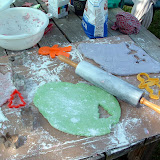
On Don's mother's to-do list for her trip this summer: make dough ornaments with Ulysses. Click the pic for more.

2007_0613 Dough Ornaments

Tuesday, June 12, 2007

Berkley Park

U and I went out and around town with Don's mother, Janice -- to the library, to Berkley Park, and all over. Ulysses and I have played together there so many times since that first Arpil weekend afternoon in 2005 when we drove there together and played among the neighborhood children out enjoying the early spring warmth. I was glad to have pix and video taken of us at the slides and swings and trees and climbing thingies we've spent so much time with.

Click the picture below, then click the "Slideshow" button, to see the whole thing, including a few short movies.

2007_0612 Out and About

Saturday, November 11, 2006

Slava with a friend, and Djuvec recipe


My friend Michelle came over to celebrate Slava with us today, and we cooked and feasted into the late hours. Michelle is fast becoming our Serbian holiday co-celebrant de rigeur -- she's already come for two Serbian Christmases in a row.

November 14 is my family Slava -- a Serbian custom celebrating the patron saint of the family. In my case, we have two, Sveti Kuzman i Damian (Cosmas and Damian). Slava originated way back when the Serbs converted to Christianity; the history is not completely known, but it's thought that they didn't want to abandon their family patron gods. That was the dealbreaker. When offered patron saints to replace their family gods, the pot was, evidently, sufficiently sweetened.

It's not known (as far as I can tell) whether the saints and saint days chosen corresponded in some way to the original gods of the household. Some say the date of a family's Krsna Slava is the anniversary of the day the family was originally baptized into Christianity. At any rate, I'm happy to observe it each year because the lineage reaches back into Serb antiquity even farther back than Serbian Orthodoxy, which is itself, in discourse at least, so often the non plus ultra of Serbian identity and heritage .

Most articles I've found on the Web (here's one) that explain Slava are heavily doctrinaire, and choked with a peculiarly stuffy religiosity that makes it hard for me, at least, to read. I do like this Wikipedia article.

Being an American, too, I made merry on the weekend date closest and most convenient to the authentic date. That's the American way of observance. (Thanksgiving is a notable exception; if it were being established today, it never would be set as a Thursday. And Christmas and New Year's Day wander peskily throughout the week. VIP birthdays and other commemorations, though, may be condensed and corralled with impunity to benefit the business calendar.)

Any get-together is a good reason to make fabulous food, especially a Serbian holiday. We made gibanica, djuvec, pogaca and, of course, kolach. I plan to get recipes for absolutely everything up on the blog eventually. For now, here is a heavenly djuvec. Enjoy!

Djuvec (JOO-vech, with a hard “j” as in “jingle”)
(Meat and vegetable casserole)

Djuvec is a Serbian layered casserole. It falls into the category of one-pot meals that are named after the vessel in which they are prepared. Another example is, in fact, the casserole; it’s the French word for a shallow baking pan.

Djuvec at its best is mellow and succulent, with a complex play of meat and vegetable flavors. It’s meant to be served straight out of the pot. As the top layer of sliced tomatoes roasts and concentrates, it becomes both decorative and delicious

I’m amazed by how much flavor this dish carries, since the seasoning is so minimal. It’s a wonderful tribute to the powerful deliciousness of vegetables. Tasting this dish, I realized I’ve come to rely on herbs, spices and stocks to create the flavor profile of a dish, using vegetables mainly for their volume, texture and color – but not especially for flavor. This djuvec brings home how potent are the tastes of tomato, of eggplant, of bell pepper, of celery. Onion, too, even though it isn’t caramelized, is a big player in this dish.

This recipe is adapted from one that I found in Yugoslav Cookbook (1963, Izdavacki Zavod Jugoslavija). That one calls for green peppers instead of red, and for 3 pounds of fresh, sliced tomatoes, instead of 1 pound fresh and 2 cans of crushed. The book calls for equal parts beef and pork, or, alternately, lamb.

It doesn’t specify what cut of pork (or anything else) to use. I chose country-style ribs – a cheaper cut with a moderately long cooking time and a fairly hefty amount of fat and flavor. Its strong pork presence can be overwhelming, but that’s a strength when you want flavor that will permeate a great big pot of food. Another good choice, I’ll warrant, would be pork belly. I’d love to try this with pork we’ve smoked in the smoker we built this summer, and with other meats as well. By contrast, a bad choice would be something like pork tenderloin – a delicacy that’s marvelous on its own, simply rubbed with salt, pepper and herbs and grilled or flashed cooked to medium rare. But it doesn’t have a lot of flavor to spare, and it would just get lost in a accompanying stew.

This dish is assembled in layers. Use a heavy pot with a big footprint. This recipe will fill two standard Dutch ovens. Halve the recipe for a single Dutch oven. I used a massive French oven casserole, which is similar to a Dutch oven, but its oval shape makes it suitable for use as a roaster as well. Ours is made by Club, and it’s a beauty in white-enameled cast iron with a black enamel interior. We got it at a Goodwill in the early 1990s for 10 bucks. What a fabulous deal.

Ingredients
1 large eggplant, cubed
1 red bell pepper, diced
2 stalks celery, diced
Handful parsely, chopped
1 1/2 pounds onions, quartered
1 28-ounce can crushed tomatoes
1 15-ounce can crushed tomatoes
1 pound fresh tomatoes, sliced
1 tablespoon salt
1/4 t black pepper, approx.
4 pounds country-style pork ribs, cut off the bone and cut in 1" cubes
1 1/2 cups olive oil
1/3 cup uncooked white rice, or 1 cup day-old cooked rice

Instructions
In a mixing bowl, toss together all the vegetables (except tomatoes and crushed tomatoes) with the salt, pepper and 1/2 cup of the olive oil.

In a heavy skillet over highest heat, sear the pork until nicely browned. (Sear pork in batches small enough that they don’t crowd the pan, so that there is enough space for evaporation. Otherwise, they’ll start to boil without browning.)

Put down layers in this order:
1 can crushed tomatoes
Half of the veggies
Rice
Meat
Remaining veggies
1 can crushed tomatoes
Sliced tomatoes
1 cup olive oil

Bake at 350 F for about 2 hours, or until the meat is tender and the rice is thoroughly cooked. Remove the lid for the second hour, to get the tomatoes to form a nice crust.

Sunday, December 11, 2005

Vanilice: Serbian holiday cookies


[Note: I found out later that my memory was off. The "family friend" was actually a relation. She was my aunt's mother. That is to say, my cousins' grandmother. Specifically, she was the mother-in-law of the brother of my mother. I also found out that the cookies she made are called "vanil grancle" (pronounced VAH-neel GRAHNT-sle). There is such a cookie as a vanilica, but I had confounded the names. Use the search tool at top of page to find other posts I've written about this topic, including the real vanil grancle family recipe. – This note added 12/21/2008, VK]


Today I brought a platter of these cookies to the James Reeb Unitatian Universalist Congregation's Holiday Bake Sale. I wrote up the recipe, and the story of how I came to the recipe, and took it along. I sold the cookies for 50 cents -- 3 for a dollar -- and the recipes for a buck!

The cookies sold out. Selling the recipes made it so I could raise more $$ for the church than with just the cookies alone!

One parishoner is part Croatian. She remembered vanilice as her favorite cookies, that her grandmother used to make. She said she had tried to document her grandmother's cooking, but everything was done by feel and experience. All the amounts, she said, were either "Some" or "A little bit." She told me about how, many years after her grandmother had died, she visited an aunt who made her a whole batch of vanilice, knowing they were Mary's favorite, and gave them to her. Mary said it brought tears to her eyes.

Below is the text that I charged people a dollar for. Now you can read it for free.

Vanilice
(Pronounced va-NEE-leet-seh)

These festive, delicate cookies are a Serbian favorite around the winter holiday season, which, for Serbs in America, can stretch from the buildup to “American Christmas” on December 25 through Eastern Orthodox Christmas on January 7 and even Serbian New Year's on January 14! I remember a friend of our family who would make several hundred of these every year, freezing them in batches weeks in advance.

The finished cookie is a circular, powdered-sugar covered, jam sandwich of sorts. The top layer of the sandwich features a “window,” a round hole through which the jam can be seen. Very pretty.

This is one of the few traditional Serbian cookies that is like the kind of cookie we are accustomed to in the U.S.: an individually shaped and baked sweet biscuit made from a fairly stiff dough. Most bite-sized sweet treats in the Serbian tradition are bars cut from pans of baked batters, often topped with meringues and sprinkled with nuts, or sometimes phyllo leaf layerings.

To my surprise, I couldn’t find a recipe for these in my Serb-American cookbook, a classic published by the Serbian church in Milwaukee in the 1970s. On the Internet, all the recipes but one were in Serbian or Croatian, with the measures in metric, and it was slow going for me with my faltering way with the written language to decipher that they weren’t what I was looking for. The one recipe in English was also not the variation that I was familiar with. It didn’t even contain vanilla – and that’s what the cookie is named for! So I tinkered with recipes and came up with my own recipe that yields an authentic rendition of this classic holiday treat.

Hardware note: You will need two sizes of cookie cutters to make the rounds and the windows in half of the rounds. Scrounge about the house for bottle tops that will yield pleasing results, as I did for years – or do yourself a favor and invest a few dollars in a set of round pastry cutters at a kitchen supply store or Web site, or a restaurant supply store. These will serve you well for the rest of your life!

Production:
1 1/2 stick butter, room temperature
1/2 cup sugar
2 eggs
1 tsp. vanilla
2 cups all-purpose flour

Finishing:
Powdered sugar
Apricot jam or other kind of jam

Cream butter and sugar. Beat in eggs and vanilla. Work in the flour. The result will be a dough about the stiffness of pie crust.

Roll out to about 1/8" thickness. Use plenty of flour on the board, and sprinkle flour atop the dough so that the pin doesn’t stick. Cut the dough into rounds about 1 3/4" in diameter. Into half of the rounds, cut a hole of about 7/8 " in diameter. These will be the cookie tops. Keep re-rolling until all the dough is used.

Bake on an ungreased cookie sheet at 300° F for 10 minutes. They do not need to brown at all. Do not overbake. Let cool before handling. They are crumbly and fragile while still hot.

Spread about 1/4- to 1/2 tsp of jam on the rounds. Atop each round, place one of the rounds with a hole cut into it.

Dust each cookie with powdered sugar. To accomplish this, put about a three-inch deep layer of powdered sugar into a bowl or deep dish. Lightly drop each cookie into the sugar, first bottom down, then top down. Gently knock off any extra clumps of sugar.

Arrange on a platter. These are better at least a day later, when their flavor has had time to develop. Yield: about 3 dozen cookies.