When my friend Gigi was coming over to celebrate Serbian Christmas with us, I wanted to develop a gluten-free version of my treasured family recipe for Božićni kolač (pronounced bo-zheech-nee KO-lach) so that I could share this delicious tradition with her. It took several iterations, and I finally got something that comes close, very close. I hope you'll enjoy this moist, chewy, mildly sweet creation.
The big discovery was including whey protein. I found a couple of sites, including Gluten-Free on a Shoestring, that recommended whey protein isolate, which is really pricey. Instead, I ordered a container of my favorite whey concentrate brand, Jarrow unflavored whey protein. It has a little more non-protein content than whey protein isolate, but it still magically transformed my loaves into something much, much more like regular wheat bread. The crust, crumb, and rise are all better. The stretchy, tough characteristic of wheat gluten is the missing link that whey protein provides.
Another innovation here is the use of corn flour. Corn flour is absolutely not traditional in any holiday kolach recipe I can imagine. But in this recipe, it adds a robust quality to the flavor and texture of this brioche-like bread that was otherwise missing from these rice-flour based loaves.
This recipe is for the mini-loaf that I made. I image that you can multiply it as desired for a bigger round of kolac (kolach) as you desire. However, I haven't tried it. If you do, please let me know your results.
I used Namaste brand all-purpose gluten-free flour mix. I have no idea if this recipe will work with other mixes. I haven't done much gluten-free baking.
I can vouch for the success of the metric weight measures. I provide here cup equivalents of the measures, but such equivalents are notoriously unreliable, so I can't vouch for them.
From Gluten-Free on a Shoestring's book Gluten-Free on a Shoestring Bakes Bread, I also learned that it's safe to heat your yeast-liquid solution much higher than everyone else tells you. Nicole, the author/blogger at that site, reports that the thermal death of yeast occurs at 140º F. Warming milk or water closer to this temperature is far more effective than the tepid 100º to 110º F that is recommended practically everywhere else.
If you use salted butter, use less salt.
Note that you want corn flour and not corn meal.
1/2 cup whole milk, warmed to 120º F to 135º F
1/2 tsp. active dry yeast
1 Tbs. sugar
1 egg, separated
1 Tbs. unsalted butter, room temperature, plus more for greasing the pan
2 g (1/4 tsp.) salt
80 g (1/2 cup + 2 Tbs.) Namaste brand all-purpose gluten-free baking mix
15 g ((1/4 cup + 1 tsp.) Jarrow unflavored whey concentrate
20 g (3 Tbs.) Bob's Red Mill gluten-free corn flour
Sprinkle the yeast over the surface of the warm milk. Add the sugar. Stir together until completely dissolved. Place the mixture someplace warm for about 15 minutes for the yeast to activate. I turn on my oven to its lowest temperature and place the mixture inside. I turn off the oven when it reaches temperature, and let the inner warmth just coast.
Stir together the gluten-free baking mix, whey powder, corn flour and salt.
Add the dry mix to the yeast-sugar-milk mix.
Add the egg yolk and stir the mixture vigorously. You'll have a silky, stretchy, soft mass.
Reserve a teaspoon or so of the egg white for brushing the top of the loaf later. Place it in a teacup or similar vessel.
Beat the egg white until it forms stiff peaks. Do not overbeat, or it will break down into liquid and won't form bubbles anymore. Stir the beaten white into the dough. You'll have a softer, still silky and stretchy mass.
Grease a small loaf pan. Mine is a stoneware pan with a capacity of 1 1/2 cups.
Pour the batter into the pan. Let rise an hour or so in a warm location. I use the inside of the oven, set to 150º F and turned off to coast at warmth, as before.
When the bread is nicely risen, remove it from the oven (if it's in there) and turn the oven to 400º F.
Brush the top of the dough all over with the reserved egg white. This will bake into a beautiful gloss.
Make an aluminum foil tent for the bread pan that leaves lots of room for it to rise more. You want to protect the top from over-browning, create a little steam chamber for nice baking, and also be sure that the rising dough doesn't stick to the inside of the foil. Cover the pan with the tent.
Place the loaf pan in the 400º F oven. Immediately turn the temperature down to 350º F.
Bake 1 hour. Remove and check with a toothpick. When it's done, it'll make a hollow sound when you thump it, and a toothpick will come out mostly clean but with a few moist crumbs clinging to it.
Remove from the pan and cool on a rack.
Slice and enjoy! Prijatno!
Showing posts with label friends. Show all posts
Showing posts with label friends. Show all posts
Sunday, January 10, 2016


Wednesday, June 30, 2010
Working hard at EVP

Sigurd and I ran into one another at EVP coffeehouse. I had gone there to get some work done while Ulysses was at his enrichment summer classes at nearby Hamilton Middle School, Nico's alma mater. Sigurd had gone to get some math work done in peace and quiet away from home the last chance he had before getting ready to travel with the family this weekend to The Netherlands and Spain for the summer.
As you can see from this picture, we both got lots of work done and did not let chatting and catching up become a distraction.

Sunday, November 16, 2008
Slava 2008

Yesterday we had a bunch of people over for my Krsna Slava, the Serbian family holiday to celebrate the patron saint, a custom that stretches back into prehistory and pre-Christian times, when the Serbs had family gods. As the story goes, they were reluctant to leave their family patron gods, so each family got a saint designated instead. Because this happened in the ninth century, the saints are all really ancient ones, like Saint Nicholas. My family's is a pair of twins, Saints Cosmas and Damian (Sveti Kuzman i Damian), born in Asia Minor (or Mesopotamia) to Saint Theodota.
The icon here is the exact picture that hung on my wall when I was a kid growing up. It's the current top-of-article image on the Wikipedia entry about them. In past years, I've seen other icons on the Wikipedia page and other pages that my Internet searches turned up. So it was a surprise, and gave me an unexpected eerie feeling, to see this very picture after so long.
More about Slavas past here:
http://vesnavuynovich.blogspot.com/search?q=slava
The custom in the Old Country is to have lots of people over all day, coming in and out, with lots of food. I never experienced that, because we didn't live in a place with a big Serb community, but it sounds like fun, so that's what I went for yesterday. Also a priest comes over and blesses the home, but of course we didn't do that, either. We did invite a Universalist Unitarian minister -- as a guest, not in an official capacity -- but he didn't show.
For many years, Don and I would just go out to dinner on my Krsna Slava, November 14. Somehow we always seemed to wind up at a Mexican place -- Pasqual's or Pedro's or Laredo's -- so that we started feeling like the Slava custom was to go out for Mexican food. Once we went to a wonderful Laotian place, Lao Laan Xang, with our friends Sigurd and Gloria -- that must have been 1999 or 2000, because it was the year I wrote about them for the Isthmus dining guide. I'm not sure what inspired me to start celebrating at home and experimenting with Serbian food instead. A few years back, we began inviting our friend Gigi, who's become our Serbian holiday co-celebrant. This year, for the first time, I decided to do something closer to the real thing and invite a whole bunch of people, as many as I dared invite to our small space and cook for all at once. It worked out great and gave me confidence to expand the guest list even more next time around. Sigurd and Gloria were there, the Dutch and Spanish mathematicians we befriended almost immediately after moving to Madison, as well as their kids, Nico (now 14) and Vicky (now 9). Also our neighbor Jayne, from across the street (we offered to give her a ride) and our friend Jennifer. Later my co-worker Jill came, along with her partner Mary. Finally my former co-worker Gil, from Israel, showed up. He was lost in the mobile home park, so I directed him over the phone, and went out into the street and waved him into a spot before running back into the house -- I was barefoot and chilly. Somehow he couldn't figure out which house was ours in the dark, though, and after we waited minutes for him, some folks went outdoors to find him, wandering around the street trying to find the house. Yeah, I know, I don't get it either. Sorry, Gil. (Unfortunately, Gigi, who loves sharing Slava with us, couldn't come at the last minute -- her father had to get emergency eye surgery. We're still waiting to hear how that turned out, and of course we hope for the best.)
Well, I must say I am proud of myself for pulling this thing off. I planned all week, stayed up late cooking and prepping Friday and got up early and got cooking Saturday. It turned out to be the most tactically succesful of all the fun food parties I've thrown over the years. By that I mean: when the first guests started showing up, I had already changed out of my pajamas. And showered. And had completed enough of the cooking that I was actually able to enjoy the party! Here's what we had.
Slatko
Traditionally, whole fruit preserves, extremely sweet. Served in a jar, presented on a tray alongside several cups of cold water and a pile of dessert spoons. Each guest, on arrival, eats a single spoonful of slatko and chases it with water. The slatko I made for this occasion was apricot jam and honey. Someday I'll try to make my own from scratch. Maybe. Canning still intimidates me.
Kolach
One of the central, sacred dishes that must be on every Slava table. This tall, round loaf can be regarded either as a tremendously rich, cake-like bread, or the breadiest, most un-sweet pound cake you've ever had. The word means "cake" in Serbian (and just about any other Slavic language, too). The recipe is passed matrilineally through the generations, just as the Slava saint is passed patrilinealy. I like the way that sort of balances things out. And the crisscrossing, continuous invigoration of the family tradition it makes for. My recipe comes from my mother (b. 1920), who had been Nada (Nadezhda) Jankovic. and from her mother (b. 1888), who had been Ljubitsa Stephanovic, and from her mother, who had been Radivojevic, and from her mother, who had been Bojic. So you see that it is a very old recipe, because this lineage is only the beginning. The recipe is posted here:
http://vesnaswriting.blogspot.com/2009/01/serbian-christmas.html
This year I incorporated the famous no-knead bread technique that swept the foodie blogosphere after Mark Bittman's 2006 New York Times column came out here:
http://www.nytimes.com/2006/11/08/dining/08mini.html?_r=1&oref=slogin
http://www.nytimes.com/2006/11/08/dining/081mrex.html
and by gum if it didn't work just fine. In a big crockery bowl, I mixed up the usual Kolach ingredients on Friday night. They came out wet and sticky -- depending on the weather, you have to add milk or add flour to get the dough to the right consistency for kneading. In this case, I left if just as it was, and covered the bowl with clingfoil. In the morning, it had risen perfectly, with bubbles on top and all. I added a bit of flour and folded it over and over a few times. Then I put it in a well-buttered crockpot liner, covered it with its glass lid, and let it rest and rise for a couple of hours. After that I baked it in the oven as usual -- 400 uncovered for 10 minutes, then 350 covered with the crockpot lid for an hour. Perfect results, most of the work done overnight, and the oven freed up early on for all the other stuff that needed to go into it.
I sure wish I had two ovens. Or three.
Koljivo (Zito) (KOHL-yee-voh, ZHEE-toh)
This is another sacred dish, and one of the three elements de rigueur on a Slava table. (The third is a white candlestick ablaze.) (A fourth element needed in the room would be an icon of the saint or saints whose day it is.) It's made only for three occasions: Slava, Christmas, and for a funeral or requiem. My friend, an elderly Serbian woman in Madison I'll call Sophy S., tells me that only for the commemorating the dead is it decorated with slivered almonds arranged in the shape of a double cross. For Slava and Christmas (Bozic), it's decorated with slivered almonds stuck all over like a porcupine. However, searching for info about Koljivo on the Internets on Friday night, I came upon a picture of Slava Koljivo that was decorated with a cross.
So what is it? Essentially, boiled, then ground, wheat berries. The symbolism is powerful, especially when it's made for the dead, for what is death but the ultimate harvest? So saith the Reaperman. The wheat is mixed with ground nuts and powdered sugar. It's sweet and incredibly rich, so a tablespoon of this is a hearty serving. No kidding. Top it with whipped cream. You don't serve this for dessert; you eat it before the meal. Remember, just a tablespoon, or less. Save room for dinner.
Koljivo recipe in a separate post.
Gibanica (GHEE-bah-Neet-sah)
Call it Serbian cheese bread, call it savory cheese pie or strudel, call it flaky cheese casserole -- there's no ready American analog for this room-temp wedge of cheesy, flaky goodness, one of the most typical of all typically Serbian dishes. Read about it in this previous post:
http://vesnavuynovich.blogspot.com/2007/11/gibanica-flaky-savory-cheese-pie.html
The big discovery I made this year was to use only 3/4 of the package of filo, instead of the whole pound. For the first time, my giba was puffy on coming out of the oven, as recipes suggested it would be. Best yet, with the dough-to-cheese ratio more favorable, the result was way more cheeeesy. That's a good thing.
Djuvec (JEW-vech)
Ah, djuvec. That wonderful one-pot meal. Pork and/or beef with veg, cooked long and slow in a big pot with just enough rice to soak up the juices that exude from the eggplant, tomato, celery, parsely, onion and meat herein. I've written it up before:
http://vesnavuynovich.blogspot.com/2006/11/slava-with-friend-and-djuvec-recipe.html
This year I made it with equal parts pork shoulder and beef shoulder (I'm guessing that's another name for chuck, don't know why they called it that at the UW Provision Store where we buy in bulk to load up the standalone freezer we splurged on this summer); previously I'd used all pork. Also I upped the rice to 1/2 cup, but I think it could have taken more. The rice sort of disapperd amidst all the rest. Used a new (to me) rice this year, also: an organic variety grown by Lundberg but packaged and sold for Asian-American markets.
Pogaca (POH-gah-cha)
I made a "Farmer's Pogaca," a recipe adapted from the 1963 "Yugoslav Cookbook" printed by the state. Of course, in 1963, just about everything in Yugoslavia was done by the state, as it was a comprehensively socialist economy. Everything from the Zastava factory, where Yugos were made, to most larger restaurants were owned and run by the state. When I traveled there in 1989 I learned quickly to avoid those restaurants. They had the ambiance of, say, a DMV here in the states. Can you imagine the charm of ordering a meal from the person behind the counter at the Department of Motor Vehicles? Asking them the difference between the shopska salata and a Srpska salata listed on the salad page? That was pretty much the flavor of the interpersonal transactions at such places. Small, privately run inns and cafes were the place to go for a warm, southern Slav experience. And good food more redolent of tradition than of institution.
Pogaca is bread, and it can be as plain and dressed down as kolach is rich and resplendent. Usually it's a yeasted flatbread, round and meant to be broken, not cut. There are many versions, including bogota pogaca, meaning "rich pogaca," with extra special ingredients like buttermilk and egg yolks, that's flaky and folded, sort of like croissant.
This "farmer's flatbread," though, is just flour, water, yeast, salt and oil. Easy, quick, and a great side to a hearty meal. The recipe makes three 10-inch pogace.
Farmer's Pogaca recipe
1 1/2 cups water
1 1/2 teaspoon yeast
6-8 cups flour ( I used 2 cups whole wheat and the rest AP)
1 1/2 teaspoon salt
1/4 cup olive oil or other fat
Beaten egg (for brushing over top)
Dissolve yeast in warm water. Add remaining ingredients. Mix to a medium dough. Knead for 5 minutes. Let rest 15 minutes. Divide in thirds. Roll to size and shape of layer cake pans. Lightly grease the pans. Place dough inside. Brush dough with beaten egg. Dock (prick all over with a fork.) Bake 20–25 minutes at 425, or until golden brown and done. Serve hot, or whenever.
I forgot to dock and brush with egg yesterday. I learned from this that the docking keeps weird bubbles from misshaping these.
I used these for dipping the ajvar, which is the next speciality on the menu.
Ajvar (AYE-var)
Also known as eggplant caviar or sweet red pepper relish, this can be made with either or a combination of these as the main ingredient. The word is etymologically related to "caviar," so I'm supposing the eggplant version came first. However, on Serbian tables I've usually seen it as mostly or all pepper.
I've heard that it can be spicy hot or not, but I've only encountered it non-spicy in person.
Srpski Ayvar recipe
1-2 eggplants
1 red bell pepper
5-6 cloves garlic, still in their peels
1/2 cup olive oil
1/2 teaspoon salt
1/4 teaspoon pepper
1 tablespooon paprika
fresh lemon juice to taste -- a teaspoon or two.
Place the eggplants, pepper and garlic on a shallow baking sheet -- for instance, a cookie sheet -- and roast at 350 for 1–2 hours, until the eggplants have totally collapsed. The bell pepper and the garlic will certainly be done and need to come out of the over after an hour; the eggplant might take an hour or so longer. Every fifteen or twenty minutes or so, turn everything over so that as much surface as possible spends some time in contact with the cookie sheet.
If you make this in the summer, you can grill instead of roast the veg, and get a wonderful smoky aroma in the bargain.
Remove from oven and let cool. Placing the veg in a brown paper bag will make the peeling go easier.
When your veg is cool, peel 'em all. Discard the seeds and core of the pepper as well as its peel.
Process all this in a food processor, adding the oil, salt and pepper. Add lemon to taste. Serve as a dip.
I just realized I forgot the paprika. So much for all that tactical success, I guess. Well, I suppose that means the paprika is optional, because that ajvar was pretty darn tasty.
Snezani Jabuke (SNE-zhah-nee JAH-boo-keh)
Literally, snowy apples. OK, the Yugoslav Cookbook (1963) just calls this "Baked Applesauce." But what's the fun of that?
Deep into the evening, I said I was going to make dessert. Don looked like he was going to fall over on hearing that -- everyone was pretty well stuffed by that point. However, I was determined. That Kolach uses egg yolks only, and I had noticed this recipe the night before -- it uses egg whites. Finally, something to do with all those egg whites I can't bear to throw out and therefore collect in a seal-top plastic bowl and keep in the refrigerator for several days until it goes bad and I throw it out later!
Snezani Jabuke recipe
2 pounds apples (about 8 apples -- exactitude is not necessary here)
2 egg whites (or however many you have on hand)
1/4 cup sugar
Peel, core and slice apples. Place in a saucepan with a few tablespoons or so of water (just enough to keep from scorching) and cook at medium-low heat until soft.
Turn apples into a buttered pie plate or casserole dish.
Beat egg whites stiff, adding sugar partway through. Spread on top of apples, making pretty peaks with your spatula.
Bake at 400 about 20 minutes, until golden brown.
Spoon into custard cups or any little dessert dishes. Serve hot or cold.
You may notice this is not applesauce. The Yugoslav Cookbook had involved instructions for rubbing and grinding and grating the apples into applesauce before turning them into the dish. But I thought, what for? As it stands, this is sort of like a crustless apple meringue pie. And about as fast as a baked dessert can get -- especially if you have an Apple Robot on your side.
Srpska Kafa, Slivovitz (Serbian coffee, plum brandy)
These would have been great, but I forgot to bring 'em out. OK, I said most tactically successful so far. Not perfect!
Sunday, February 17, 2008
U's Fourth Birthday, Part IV
I enlisted other guests' party services while I frosted the cake. Jennifer mixed icing colors for decorating the cake. Gloria, Vicky and Nico festooned the kitchen/dining area with "Happy Birthday" balloons (Jennifer kindly stopped to buy them on her way) and Hot Wheels crepe paper streamers.
These were the same rolls of Hot Wheels streamers that Don's mother bought when she was here for U's second birthday. It had been really hard to find party stuff at the party store that didn't have licensed character stuff on it: Spongebob, Dora, Barbie, Hot Wheels. We hadn't been able to find trademark-free streamers at all, so I decided on the Hot Wheels streamers, because, outside the commercial turnoff, they were cool looking: orange flames racing down a red background. The design actually worked with the concept of a streamer, unlike all the others.
***
Sigurd's job was blowing up balloons, to Ulysses's delight. The rest of the gang, when they were done making the streamer maze in the kitchen, joined S and U in the living room and formed a balloon-blowing-up-and-playing-with team. Gloria taught Ulysses the game of bat-the-balloon-in-the-air-and-don't-let-it-touch-the-ground. I watched and listened to the laughter and happy shouting while I puttered with the cake.
***
Ulysses ran into the kitchen -- to find me, to check on the progress with his cake, I guess. Or to tell me about the balloons, perhaps. But before he could tell me what he was about, he stopped short, looking up at the streamers and balloons everywhere.
"A party!" he said. "For me!"
"Yes!" I said. "It's your birthday party."
Ulysses lifted his arms out by his sides and began to hop up and down. "I'm dancing, Mama!" he said, smiling up at me. "I'm dancing!"
***
On Christmas day, Ulysses never did get around to opening all his presents. This morning, I'd re-wrapped in birthday-ish paper those little packages -- a Hot Wheels car still in its blister pack, a mesh sack of gold-wrapped chocolate coins, a jelly candy in the shape of a Christmas tree. He opened one of these to find a miniature ring toss game -- the kind where you press down on a button to make the rings swish through the water, and, ideally, land on a little peg. It was packaged in cellophane alongside a lollipop. "Merry Christmas!" the packaging announced. The lollipop was oblong, about 3/4" wide and 2" long, and striped diagonally with white, brown and forest green.
"Open, Mama-Tata! Open eh lollipop!" Sigurd pulled out his jacknife and worked free the tight neck of cellophane on the pop's stick.
Ulysses slipped away to the laptop workstation we set up for him recently, where he can stand and jump while he plays. He settled into some game play, licking on his lollipop, and the rest of us settled into conversation.
All at once, there was a cracking sound, and a scream came from Ulysses. The lollipop had somehow shattered into dozens of bits. Maybe it was exposed to heat or cold somewhere along the line? Or rattled against the ring-toss toy?
Don got to him first, with words of comfort. Ulysses held the lollipop up, smiling a little.
"Hix it, Tata," he implored. "Lollipop je broken."
"I can't fix that, Ulysses," he said. "It's too broken. I'm sorry."
A moment went by. Ulysses's face crumpled into tears. He sobbed and fell into Don's arms, then began to wander in little circles, crying quietly.
I remembered that in my handbag was a cinnamon lollipop U had picked out on our last visit to Shopko about a month ago. He'd never asked for it after we left the store. I ran to get it.
"Look at this Ulysses," I said, holding it near him. He turned quickly to see. The hope on his face turned dark. He shook his head slowly and looked at me.
"That's not a birthday lollipop," he choked through his tears.
I wish I could remember what Gloria said a few moments later that distracted him and made him laugh, forget the calamity of the birthday lollipop, and rejoin the party joy. She's better at cheering children up than I'll ever be.
Sunday, November 18, 2007
Gibanica, Guzvara: a flaky, savory cheese pie
This is a classic dish among Serbians. Gibanitsa (pronounced GEE-ba-nee-tsa), or guzvara (GUZH-va-ra), as near as I can figure, belongs to a class of savory cheese-and-sheet-pastry dishes known as pita. Others include burek, zavijaca, uvijena pita zeljanica and just pita.
It's made with pastry leaves, stuffed with a creamy, savory, feta-based filling and baked into a golden-brown, flaky pie. Like other custard-based dishes, it's best served at room temperature, and is tastier the day after making. I don't know what it is about baked egg-and-dairy things -- quiche, cheesecake, pumpkin pie -- but they are oddly tasteless when you pull them from the oven. Its got to be something about the protein coils of the egg and milk being tightly wound in the heat, and then relaxing so that the flavor can be released on the tongue, or something like that. If anyone knows, I would love to find out.
For the pastry dough, filo is used in America. That's the paper-thin dough used in baklava. These days, it's not hard to find in the freezer section of supermarkets, as well as European ethnic groceries. But some say a thicker-leaved product called "kore" should be used. The dish is originally more rustic than the delicate sheets of filo make it.
The name "guzvara" is a form of a verb meaning "to crumple together something that's drenched." This refers to the practice of dunking the dough sheets into the filling, and placing them, soggy and loosely crumpled, into the pan, The pan is first lined with flat sheets of pastry. The creation is covered with flat sheets cut to fit the pan. The overhang from the bottom sheets is folded over the top. Then it's baked. Traditionally, it's round in shape and served upside-down.
Years ago, I found a gibanica recipe on the Internet and made it several times. This year, I was distressed to discover that I'd never printed out or saved a copy, and it took me hours to find it again. (Thanks, Donald for suggesting dejanews.com) Here it is. A man named Vojin Janjic in Chattanooga, Tenn., posted it on soc.culture.yugoslavia in 1996! Is the Internet amazing, or what? Vojin's post includes a lot of background detail that's missing in the other recipes I found on the Net. The recipe itself also has cool features that the others lacked.
No other recipe that I found made any mention of the dunking and squashing. All were layered dishes, like baklava. I suspect that "gibanica" can be either layered or else dunked and stuffed, and that "guzvara" is the variation that's specifically dunked and stuffed.
Many used a combination of regular and low-fat cottage cheese (the latter of which is, of course, a fabricated, additive-filled abomination). What's up with that? Some didn't even use feta, or the flavorful Serbian "white cheese" that authentically belongs in the dish. Well then, why even bother?
Another difference in this recipe: sparkling mineral water. I'm not sure what that's for. Since mineral-laden water is base, and leavening agents work by pitting acid against base to form explosively foamy chemical reactions, I speculate it's for puffing up the giba. (Buttermilk + baking soda works like this. Baking powder does, too: it's a combo of acid and base powders that react in the presence of water or heat. (Double-acting baking powder has two combos: a liquid activated and one heat activated.)) But what's the acid? Maybe the tangy feta.
Vojin has you separate the eggs and beat the whites stiff. You fold it into the cheese-egg mix for added puff. Easy enough. He says you can substitute baking powder, but he doesn't recommend it.
For all this attention to leavening, the giba is not especially airy. It's dense and moist. Maybe the idea is that without these steps, it would be leaden. As is, it's just right.
What follows is based on Vojin's post. Some of his instructions were incomplete or admitted guesses. I've written here the specifics that I've found to work, and some clarifications of method. The words below are my own. (Don't you hate when people copy and paste into their Web pages with no attribution?)
3/4 package filo (phyllo) dough
[11/15/2009: This post originally specified a full, one-pound package. But in 2008 I discovered that with less dough you get a prettier, puffier, much cheesier pie. And with 25% less starchy carbs!]
2 cups (2/3 pound) feta cheese, crumbled
1 cup sour cream
1 cup ricotta
3 tablespoons of sparkling mineral water
2 eggs, separated
olive oil for greasing pan
First, prep the baking pan. A clear, deep, round casserole is ideal.
Generously grease the pan with olive oil. Gently press a sheet of filo into the dish, letting the rest hang over the edges. Repeat with another sheet, placed crossways from the first. Repeat for a total of four sheets. Use scissors to trim the overhang all around to a length of about 2".
Take a stack of four filo leaves. Use scissors to trim them into a circle that just fits inside the top of the casserole dish. This will become a lid a little later on. (You do it now so that you don't run short of filo at the end.) Put it aside.
Stir together yolks, feta, sour cream and ricotta. If mixture is stiff, thin with a little milk. Stir in mineral water.
Beat egg whites stiff. Gently fold into cheese mixture.
Dunk a sheet of filo into the mixture. Gently crumple it and place it into the pastry shell you've created. Repeat until all the filling is used. You'll want to keep one hand clean for picking up the filo sheets, or have a friend pass you the sheets.
Place the filo "lid" on top. Fold the overhanging rim of filo over top. Cover with foil.
Bake at 400F. Bottom should appear crunchy and golden brown (this is why a clear dish is handy). The top should also be browned. You can remove the foil to help along the top browning. Don't worry about overcooking, as long as nothing's burning.
After it's cooled a bit, turn upside-down onto a platter. Serve when completely cooled. Also great chilled.
Enjoy! Or, as the Serbs say, "Prijatno!" (PREE-jat-no)
Saturday, November 17, 2007
Slava 2007
Slava! I described this Serbian family holiday in this post from last year.
http://vesnavuynovich.blogspot.com/2006/11/slava-with-friend-and-djuvec-recipe.html
This year we ended up moving the celebration to the Saturday after Nov. 14, and our friend Gigi (formerly called Michelle in these pages) came and feasted with us. This time I started cooking when I got up at 7 am, so by the time I went to pick her up at 6:30, everything was ready. I was actually able to sit and enjoy a meal with a guest, instead of cooking through the courses. What a concept.
Tomatoes
On-the-vine were, mercifully, on sale. Sliced, with olive oil, salt and freshly ground black pepper.
Kolach
I made my family kolach as described in the recipe I published in Isthmus several years ago. For the first time ever, I dared to made a change: 2 cups whole wheat flour and 5 cups AP, instead of 8 AP. It turned out quite different: more fluffy and grainy, a lighter, less densely cake-like texture. Very nice. Slava and Christmas use bread, but the Slava kolach is undecorated. This recipe makes two crockpot-liner-filling loaves.
http://vesnaswriting.blogspot.com/2009/01/serbian-christmas.html
Djuvec
I made the same fantastic djuvec as last year (recipe and explanation in the link above), with one variation. Instead of 4 pounds country-style ribs, I used 2.25 pounds pork belly and nearly 3 pounds country-style ribs. I asked Gigi what she thought of this djuvec versus last year's. She said she liked this year's better; that it seemed "meatier." No wonder! At five pounds instead of four, that's a 25% increase in the amount of pork in the pot!
On Wednesday, I had purchased over four pounds of pork belly at the Angkor Thom Market, the Cambodian grocery where I like to buy less mainstream cuts of meat. Pork belly sounds awful to the delicate ears of most modern Americans who for some reason don't mind eating meat products that really are revolting, like anything containing "mechanically separated chicken." It's the part of the hog that's used to make bacon, and it's a slow-cooking, full-flavored cut that keeps good body even after it's cooked tender. That last feature makes it forgiving in dishes like this one; it won't disintegrate into the pot. I think. I haven't used it much, so I was eager to try.
What I didn't realize was that it's sold with the tough, thick skin still on. That amounted to nearly half of it by weight! So I ran out to Pierce's (closer) for more pork. No pork belly there, of course. Hence the country-style rib.
Anyway, the extra meat helped improve the ratio of starchy carbs (from the rice) in the dish. I toyed briefly with the idea of leaving the rice out entirely, but then it wouldn't be djuvec anymore; just oven-cooked stew.
The most miraculous thing about this dish, to me, is how you don't need to add a drop of water to cook the rice. All those vegetables have enough locked up in their cell walls. It all expresses while cooking, and the rice is ready to absorb and transform, using the flavored veg liquid to soften and puff. It's a beautiful, complementary alchemy.
Gibanica
A baked pastry casserole filled with a savory feta blend and served at room temperature. I'll give a fuller description and a recipe in a separate post.
Wednesday, October 31, 2007
Halloween prep
This neighborhood we're going to also has people who do up their houses to thrill the children on Halloween night. I am looking forward to it!
Unfortunately, the children of our friends are going to be off doing their own thing. Nico, 13, is doing something with his friends and Vicky, 8 is doing something with her friends. Gloria, a mathematician, is working on a grant proposal that's due tomorrow. So it's not the big H fest I've been looking forward to having with them for years.
The good news is that Sigurd is happy that we're coming -- otherwise he was going to be alone all night on door-answering duty.
For the robot costume, last week I got a lot of really cool gold-faced cardboard scraps at work that were being thrown out. I spent some time on the web researching robot costumes and came up with a sandwich-board concept. But then Donald nixed a boxy homemade robot because of safety. He didn't want any hard edges around U's neck, etc. I agreed immediately, once he put it that way.
I took U shopping for a costume on Sunday. I thought it would be best to wait until the last minute. I was really disappointed by the selections -- everything was Caribbean pirates, vampires and ghouls, and a few other characters thrown in.
We went to a thrift store that has a lot of new Halloween merchandise, but didn't find any ready-made costumes that U was remotely interested in. While there, we heard a father mention to his son that there was a used cowboy costume on the rack. Ulysses heard that and got excited by the idea of a cowboy. That costume was way too small, but I managed to find some basics on the regular clothes racks: a red plaid shirt and a denim vest with red piping!
We looked everywhere for a cowboy hat, but nobody has them! We went to a Halloween superstore kind of thing, and stuff was flimsy and expensive, which I was expecting, but not to that degree! $55 for a Thomas the Tank Engine costume. $30 for a Sherrif Woody: an already-beat-up-while-still-brand-new foam hat and a cheesy-looking coverall.
I thought that was so weird, that children's cowboy hats were impossible to find. Next year I'm going to get a jump on things and look for essential props on eBay.
I put out an e-mail at work for a cowboy hat, and someone brought me a red child's cowboy hat today! Someone else brought me a red kercheif.
Remember the gold cardboard? On the computer at work, I drew a sherrif's star -- 5 pointed, with little circles centered over each pointed -- somehow, the circles make it seem really Western -- and the automated computerized cutting machine people were nice enough to offer to cut it out for me. (I was going to hack through it with an X-acto.) I sewed Velcro on the denim vest, and attached the gold star.
So U has a red hat, a red kerchief, a denim vest with red buttons and red piping, a red plaid shirt, a gold star, and blue jeans. I thought of drawing a Wyatt Earp mustache on him, but I think it's better to keep it simpler at this point. He might think he wants the mustache but then get freaked out by seeing it out of the corner of his eye, or something like that.
I can't wait to see if I can get the costume/trick-or-treat concept across. If he puts his costume on, it will be adorable.
Monday, October 15, 2007
Missouri trip, Day 6: Tuesday
Tuesday we drove home.
We stopped in Platteville, Wis. and I got a McDonald's iced coffee to see what all the fuss was about. Donald had never even heard of them. I thought it was the fakest thing I'd ever tasted. Yuck. I got it plain. It was so pumped up with coffee flavors, and so syrupy with sugar. I can see why people like it. Those are all appealing flavors. But once you get turned off to the taste of Fake -- ick.
We stopped in Platteville, Wis. and I got a McDonald's iced coffee to see what all the fuss was about. Donald had never even heard of them. I thought it was the fakest thing I'd ever tasted. Yuck. I got it plain. It was so pumped up with coffee flavors, and so syrupy with sugar. I can see why people like it. Those are all appealing flavors. But once you get turned off to the taste of Fake -- ick.
Missouri trip, Day 5: Monday
Sharon had to go to work today.
Donald and Ulysses and I visited the smallish supermarket down the street, which is much closer than the Wal-Mart, if I do say so, and was so friendly and nice. We bought some coffee that we'd never seen at home, and we got her some kitchen supplies that it seemed she'd run out of. We also bought groceries to make some yummy dinner with. Sharon is leaving vegetarianism after decades of practice, and we've been taking the opportunity to share whatever we know about cooking non-vegetarian food with her. Of course, I can relate to her experience somewhat. But her process is different from mine. Partly it's because she's moving to a country where vegetarianism is practically unknown. Partly, she says, it's because she wants to be an easier mate to her fiance, not that he isn't estatic with her just the way she is.
We got some ground beef and figured we'd teach her how to make a good, basic meatloaf. An endlessly flexible entry in any repertoire.
I got a cute little pie pumpkin at the pumpkin place on Sunday. Ulysses was desperate to have me cut it in half; I don't know why. He kept making cutting motions with the side of his hand. At one point, for a moment he somehow even got hold of our 8" Dexter Russell chef's knife that we'd brought along from home and made as if to do the job himself! Yikes!
I was reluctant to cut the pumpkin, because if I was misinterpreting his request, or if he changed his mind, there would be wailing and gnashing of teeth over the murdered pumpkin. Finally, today after we got back from the market, I cut the pumpkin for Ulysses. He was thrilled!
Then Donald and I had the idea to stuff the pumpkin with the ground beef! I hollowed out much of the pumpkin flesh and spread out the seeds to dry out for toasting later. We mixed it with the beef, and wow! It was one of the best meat loaves we've ever had! We cooked and mashed potatoes, also. And we had tossed green salad. A lovely supper.
Meantime, the day. At noon we met Sharon for lunch at a Burger King that boasts Missouri's largest indoor play structure for children. This thing took 10 entire minutes to climb to the top of! Then you slide down a loooooong spiral slide. That takes about 40 seconds. Pretty long for a slide. You have to work for it! Sharon, Don and I took turns going up the thing with Ulysses. Sharon's energy, as always, amazes me.
Donald and I went to a park after lunch and hiked with Ulysses. We had gone there with Sharon on our last visit a few years ago.
More later.
Donald and Ulysses and I visited the smallish supermarket down the street, which is much closer than the Wal-Mart, if I do say so, and was so friendly and nice. We bought some coffee that we'd never seen at home, and we got her some kitchen supplies that it seemed she'd run out of. We also bought groceries to make some yummy dinner with. Sharon is leaving vegetarianism after decades of practice, and we've been taking the opportunity to share whatever we know about cooking non-vegetarian food with her. Of course, I can relate to her experience somewhat. But her process is different from mine. Partly it's because she's moving to a country where vegetarianism is practically unknown. Partly, she says, it's because she wants to be an easier mate to her fiance, not that he isn't estatic with her just the way she is.
We got some ground beef and figured we'd teach her how to make a good, basic meatloaf. An endlessly flexible entry in any repertoire.
I got a cute little pie pumpkin at the pumpkin place on Sunday. Ulysses was desperate to have me cut it in half; I don't know why. He kept making cutting motions with the side of his hand. At one point, for a moment he somehow even got hold of our 8" Dexter Russell chef's knife that we'd brought along from home and made as if to do the job himself! Yikes!
I was reluctant to cut the pumpkin, because if I was misinterpreting his request, or if he changed his mind, there would be wailing and gnashing of teeth over the murdered pumpkin. Finally, today after we got back from the market, I cut the pumpkin for Ulysses. He was thrilled!
Then Donald and I had the idea to stuff the pumpkin with the ground beef! I hollowed out much of the pumpkin flesh and spread out the seeds to dry out for toasting later. We mixed it with the beef, and wow! It was one of the best meat loaves we've ever had! We cooked and mashed potatoes, also. And we had tossed green salad. A lovely supper.
Meantime, the day. At noon we met Sharon for lunch at a Burger King that boasts Missouri's largest indoor play structure for children. This thing took 10 entire minutes to climb to the top of! Then you slide down a loooooong spiral slide. That takes about 40 seconds. Pretty long for a slide. You have to work for it! Sharon, Don and I took turns going up the thing with Ulysses. Sharon's energy, as always, amazes me.
Donald and I went to a park after lunch and hiked with Ulysses. We had gone there with Sharon on our last visit a few years ago.
More later.
Friday, October 12, 2007
Visit to Sharon's, Day 2
Sharon couldn't start her car this morning. She said it sometimes acts up, but always starts after a minute or two. We all sat in her van for about 10 minutes while she tried and tried and tried and tried. Finally, Ulysses suggested, "Try the key!"
Very helpful.
It was the perfect day for the car to break down good, because we were there to drive instead. She called the mechanic for a tow, and they had it fixed by the afternoon.
We spent the morning shopping for knives and other kitchen equipment to equip Sharon with some decent stuff. Sharon wanted our advice. I told her that Don was mainly the person to get advice from. He's such a gearhead when it comes to kitchen stuff. We went to restaurant supply stores and a retail kitchen place similar to Bed, Bath and Beyond. What a spree!
We got a couple of things, but mostly Sharon needed some good knives. She got a lovely bamboo cutting board. She also got a special glove that you wear to protect your hand from getting cut while the other one holds the knife and cuts.
Sharon got a diagnosis of breast cancer this spring, and it had gone into the lymph nodes. She had an operation and lots of chemo. And I think radiation, but I'm not sure. She says it's critical that she doesn't strain the arm on the side where the cancer was, or get a cut on that hand, because she could develop a permanent swelling called lymphedema. Hence the glove.
In the afternoon, I dropped off Sharon at her chemo appointment. I lent her my precious copy of Good Calories, Bad Calories to read during the three hours she needed to spend there. I went to the Columbia, Missouri library to work on my Sandra Lee cover story for Brava. Mainly I realized just how much there was to be done in that article, and how far, far, far I was from finishing it.
After picking up Sharon, we went and got her car from the mechanic's. Fast work!
This was the day we got Sonic for lunch. It was so awful. Don blogged about it on his Blogging for Pancakes site.
Sharon and I stayed up late talking. I slept on the couch downstairs with Ulysses. Don got to stretch out upstairs.
Very helpful.
It was the perfect day for the car to break down good, because we were there to drive instead. She called the mechanic for a tow, and they had it fixed by the afternoon.
We spent the morning shopping for knives and other kitchen equipment to equip Sharon with some decent stuff. Sharon wanted our advice. I told her that Don was mainly the person to get advice from. He's such a gearhead when it comes to kitchen stuff. We went to restaurant supply stores and a retail kitchen place similar to Bed, Bath and Beyond. What a spree!
We got a couple of things, but mostly Sharon needed some good knives. She got a lovely bamboo cutting board. She also got a special glove that you wear to protect your hand from getting cut while the other one holds the knife and cuts.
Sharon got a diagnosis of breast cancer this spring, and it had gone into the lymph nodes. She had an operation and lots of chemo. And I think radiation, but I'm not sure. She says it's critical that she doesn't strain the arm on the side where the cancer was, or get a cut on that hand, because she could develop a permanent swelling called lymphedema. Hence the glove.
In the afternoon, I dropped off Sharon at her chemo appointment. I lent her my precious copy of Good Calories, Bad Calories to read during the three hours she needed to spend there. I went to the Columbia, Missouri library to work on my Sandra Lee cover story for Brava. Mainly I realized just how much there was to be done in that article, and how far, far, far I was from finishing it.
After picking up Sharon, we went and got her car from the mechanic's. Fast work!
This was the day we got Sonic for lunch. It was so awful. Don blogged about it on his Blogging for Pancakes site.
Sharon and I stayed up late talking. I slept on the couch downstairs with Ulysses. Don got to stretch out upstairs.
Thursday, October 11, 2007
Missouri trip, Day 1
Hooray! We're visiting Sharon, who's moving to Turkey at the end of the year.
We started out from the house at 6 am, and arrived earlier than expected, around 2:30. We took the route suggested by Google Maps when you select "Avoid highways." A lovely ride through Wisconsin, Minnesota, Iowa and Missouri farmlands and small towns.
Sharon, Ulysses and I drove to a park with a nice playground in the evening.
Ulysess loves the dogs, Savvy and Piper.
We started out from the house at 6 am, and arrived earlier than expected, around 2:30. We took the route suggested by Google Maps when you select "Avoid highways." A lovely ride through Wisconsin, Minnesota, Iowa and Missouri farmlands and small towns.
Sharon, Ulysses and I drove to a park with a nice playground in the evening.
Ulysess loves the dogs, Savvy and Piper.
Saturday, February 17, 2007
3rd birthday party
Ulysses turned three years old on Friday, Feb. 16! We had a party on Saturday. Ulysses wore his birthday suit.
Click on the cake to see lots of pictures. I recommend you click on the Slideshow tab after clicking on the cake. It will take some minutes for the slideshow to cycle through, what with all the movies and all. Enjoy!
Le Menu
Click on the cake to see lots of pictures. I recommend you click on the Slideshow tab after clicking on the cake. It will take some minutes for the slideshow to cycle through, what with all the movies and all. Enjoy!
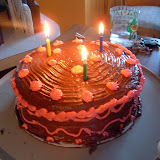 |
| 2007_0217 3rd birthday party |
Le Menu
- Corn Dogs
- Macaroni and Cheese
- Pepperoni Pizza
- Birthday Cake
Everything made from scratch, of course.
The culinary theme was kid food. We wanted to serve food that U would actually want. The only thing he ate all evening, though, was a PBJ. And cake.
Corn Dogs
We worked on this recipe for days! We were so far off at first that we decided we'd better eat corn dogs at every meal until we got it right, so we wouldn't run out of time. That's a lot of corn dogs. We started out with a recipe from a book called "Street Food" that we got at a yard sale a summer or two back. Great book, goes international! Can't find it on Amazon, or I'd give the link.
The final version included stone ground corn meal (gives a nice crunch), masa harina (gives a nice fresh-tortilla-like scent) and flour. The dogs are speared with a craft stick, then dusted with cornstarch and dipped in batter made with the dry ingredients above, plus a bit of salt and baking soda, an egg, and our wonderful homemade buttermilk. Macaroni and Cheese: We used a recipe from the April-May 2005 issue of Cooks' Country, the new publication from the makers of Cooks' Illustrated. Love it, love it. The recipe was a low-fat version. Boy, was it good, and luscious and filling, too! Where it said skim milk, I substituted whole milk. It didn't seem quite cheddary enough, so I doubled the cheddar. The crumb topping didn't seem buttery enough, so I doubled the butter. The white sauce didn't seem to call for enough butter, so I doubled that from the start. That sure was great low-fat mac 'n' cheese!
Pepperoni Pizza
Don made this. We've used lots of recipes; this one was also from the glorious "Street Food." Started with flour, yeast, warm water, olive oil, salt, made dough, let rise. Used pizza sauce we had frozen from a month or so back, made with I don't even remember what. Some form of tomatoes in a can, seasonings, salt. Topped with shredded mozz and sliced pepp. What else do you need?
Birthday Cake
 I worked from The Cake Bible for this one. Fabulous cake -- yellow with chocolate frosting. I've never eaten better cake in my life. I plan to post separately about the cake adventure.
We also planned to make guacamole and serve Breyer's vanilla ice cream in cones, but people were somehow too stuffed.
The culinary theme was kid food. I wanted to serve food that U would actually want. The only thing he ate all evening, though, was a PBJ. And cake.
Saturday, November 11, 2006
Slava with a friend, and Djuvec recipe

My friend Michelle came over to celebrate Slava with us today, and we cooked and feasted into the late hours. Michelle is fast becoming our Serbian holiday co-celebrant de rigeur -- she's already come for two Serbian Christmases in a row.
November 14 is my family Slava -- a Serbian custom celebrating the patron saint of the family. In my case, we have two, Sveti Kuzman i Damian (Cosmas and Damian). Slava originated way back when the Serbs converted to Christianity; the history is not completely known, but it's thought that they didn't want to abandon their family patron gods. That was the dealbreaker. When offered patron saints to replace their family gods, the pot was, evidently, sufficiently sweetened.
It's not known (as far as I can tell) whether the saints and saint days chosen corresponded in some way to the original gods of the household. Some say the date of a family's Krsna Slava is the anniversary of the day the family was originally baptized into Christianity. At any rate, I'm happy to observe it each year because the lineage reaches back into Serb antiquity even farther back than Serbian Orthodoxy, which is itself, in discourse at least, so often the non plus ultra of Serbian identity and heritage .
Most articles I've found on the Web (here's one) that explain Slava are heavily doctrinaire, and choked with a peculiarly stuffy religiosity that makes it hard for me, at least, to read. I do like this Wikipedia article.
Being an American, too, I made merry on the weekend date closest and most convenient to the authentic date. That's the American way of observance. (Thanksgiving is a notable exception; if it were being established today, it never would be set as a Thursday. And Christmas and New Year's Day wander peskily throughout the week. VIP birthdays and other commemorations, though, may be condensed and corralled with impunity to benefit the business calendar.)
Any get-together is a good reason to make fabulous food, especially a Serbian holiday. We made gibanica, djuvec, pogaca and, of course, kolach. I plan to get recipes for absolutely everything up on the blog eventually. For now, here is a heavenly djuvec. Enjoy!
Djuvec (JOO-vech, with a hard “j” as in “jingle”)
(Meat and vegetable casserole)
Djuvec is a Serbian layered casserole. It falls into the category of one-pot meals that are named after the vessel in which they are prepared. Another example is, in fact, the casserole; it’s the French word for a shallow baking pan.
Djuvec at its best is mellow and succulent, with a complex play of meat and vegetable flavors. It’s meant to be served straight out of the pot. As the top layer of sliced tomatoes roasts and concentrates, it becomes both decorative and delicious
I’m amazed by how much flavor this dish carries, since the seasoning is so minimal. It’s a wonderful tribute to the powerful deliciousness of vegetables. Tasting this dish, I realized I’ve come to rely on herbs, spices and stocks to create the flavor profile of a dish, using vegetables mainly for their volume, texture and color – but not especially for flavor. This djuvec brings home how potent are the tastes of tomato, of eggplant, of bell pepper, of celery. Onion, too, even though it isn’t caramelized, is a big player in this dish.
This recipe is adapted from one that I found in Yugoslav Cookbook (1963, Izdavacki Zavod Jugoslavija). That one calls for green peppers instead of red, and for 3 pounds of fresh, sliced tomatoes, instead of 1 pound fresh and 2 cans of crushed. The book calls for equal parts beef and pork, or, alternately, lamb.
It doesn’t specify what cut of pork (or anything else) to use. I chose country-style ribs – a cheaper cut with a moderately long cooking time and a fairly hefty amount of fat and flavor. Its strong pork presence can be overwhelming, but that’s a strength when you want flavor that will permeate a great big pot of food. Another good choice, I’ll warrant, would be pork belly. I’d love to try this with pork we’ve smoked in the smoker we built this summer, and with other meats as well. By contrast, a bad choice would be something like pork tenderloin – a delicacy that’s marvelous on its own, simply rubbed with salt, pepper and herbs and grilled or flashed cooked to medium rare. But it doesn’t have a lot of flavor to spare, and it would just get lost in a accompanying stew.
This dish is assembled in layers. Use a heavy pot with a big footprint. This recipe will fill two standard Dutch ovens. Halve the recipe for a single Dutch oven. I used a massive French oven casserole, which is similar to a Dutch oven, but its oval shape makes it suitable for use as a roaster as well. Ours is made by Club, and it’s a beauty in white-enameled cast iron with a black enamel interior. We got it at a Goodwill in the early 1990s for 10 bucks. What a fabulous deal.
Ingredients
1 large eggplant, cubed
1 red bell pepper, diced
2 stalks celery, diced
Handful parsely, chopped
1 1/2 pounds onions, quartered
1 28-ounce can crushed tomatoes
1 15-ounce can crushed tomatoes
1 pound fresh tomatoes, sliced
1 tablespoon salt
1/4 t black pepper, approx.
4 pounds country-style pork ribs, cut off the bone and cut in 1" cubes
1 1/2 cups olive oil
1/3 cup uncooked white rice, or 1 cup day-old cooked rice
Instructions
In a mixing bowl, toss together all the vegetables (except tomatoes and crushed tomatoes) with the salt, pepper and 1/2 cup of the olive oil.
In a heavy skillet over highest heat, sear the pork until nicely browned. (Sear pork in batches small enough that they don’t crowd the pan, so that there is enough space for evaporation. Otherwise, they’ll start to boil without browning.)
Put down layers in this order:
1 can crushed tomatoes
Half of the veggies
Rice
Meat
Remaining veggies
1 can crushed tomatoes
Sliced tomatoes
1 cup olive oil
Bake at 350 F for about 2 hours, or until the meat is tender and the rice is thoroughly cooked. Remove the lid for the second hour, to get the tomatoes to form a nice crust.
Saturday, August 26, 2006
Orton Park Fest
This post still needs links. The original Blogware post
U and I went to the Orton Park Festival with our friend Michelle, who recently moved to just about a block from there. It was the third year in a row that U and I had gone down there. I think. Maybe we just went once, two years ago. We saw Lou and Peter Berryman play -- fantastic, of course -- and bought a dark red long-sleeved T-shirt with the Orton Park Festival logo on it (No year on it, so can't use that as a clue) from a table manned by Cynthia Nolen, who was at the time a teacher at the East-West Healing Arts Institute, where at the time I was the school administrator. (I think. Unless it happened last summer.) Two years ago, I bought a sarong with the sun and moon and other celestial objects from a table with fantastic Indonesian wares, and used it in the Touching the Ground ceremony we held for then 6-month-old Ulysses the following weekend.
This year, Michelle and I walked on over and beelined to the beer tent. Or tried to -- we got sidetracked chatting with Chris, the person who, with his wife Polly, introduced me to Great Big Pictures. During the chat, U climbed down from my arms and began exploring, so I went in pursuit. Finally, success and a pair of Capital Octoberfests.
U was desperate to drink some Octoberfest. Very cute, except for the part where he wasn't going to quit and the brimming plastic pint glass was not going to survive. Brilliant idea: ice cream. We got in line at the Chocolate Shoppe booth -- ten flavors and no vanilla, can you believe it? As the last person before us was turning to leave, Ulysses found himself eye-to-scoop with her waffle cone mounded with ice cream. He was stunned. He had had no idea that the magical substance was nearby. His eyes widened and his body tensed. It was like a cartoon where the character's eyes bug out into pointy cones directed at the object of shock. "Eh!" he fairly shouted.
But, without vanilla, what flavor to get? I didn't want to spend $2.50 on a cone that might then be rejected. Fortunately, the person at the booth -- she had a 4-year-old herself, she told me -- was happy to give us a test spoon. We started with Malted Milk, after the assurance that it didn't have any pieces of stuff in it. U looked suspicicously at the spoon I held before him. "No...no," and some head shaking. I darted in with the spoon and lightly touched it to his lips, then drew it back. And waited for a verdict. First, the crinkly face. Then the look of delight. Then, reaching for the spoon. "One scoop in a cone of Malted Milk, please." Success!
And hours passed before he noticed my interesting beer again!
U and I went to the Orton Park Festival with our friend Michelle, who recently moved to just about a block from there. It was the third year in a row that U and I had gone down there. I think. Maybe we just went once, two years ago. We saw Lou and Peter Berryman play -- fantastic, of course -- and bought a dark red long-sleeved T-shirt with the Orton Park Festival logo on it (No year on it, so can't use that as a clue) from a table manned by Cynthia Nolen, who was at the time a teacher at the East-West Healing Arts Institute, where at the time I was the school administrator. (I think. Unless it happened last summer.) Two years ago, I bought a sarong with the sun and moon and other celestial objects from a table with fantastic Indonesian wares, and used it in the Touching the Ground ceremony we held for then 6-month-old Ulysses the following weekend.
This year, Michelle and I walked on over and beelined to the beer tent. Or tried to -- we got sidetracked chatting with Chris, the person who, with his wife Polly, introduced me to Great Big Pictures. During the chat, U climbed down from my arms and began exploring, so I went in pursuit. Finally, success and a pair of Capital Octoberfests.
U was desperate to drink some Octoberfest. Very cute, except for the part where he wasn't going to quit and the brimming plastic pint glass was not going to survive. Brilliant idea: ice cream. We got in line at the Chocolate Shoppe booth -- ten flavors and no vanilla, can you believe it? As the last person before us was turning to leave, Ulysses found himself eye-to-scoop with her waffle cone mounded with ice cream. He was stunned. He had had no idea that the magical substance was nearby. His eyes widened and his body tensed. It was like a cartoon where the character's eyes bug out into pointy cones directed at the object of shock. "Eh!" he fairly shouted.
But, without vanilla, what flavor to get? I didn't want to spend $2.50 on a cone that might then be rejected. Fortunately, the person at the booth -- she had a 4-year-old herself, she told me -- was happy to give us a test spoon. We started with Malted Milk, after the assurance that it didn't have any pieces of stuff in it. U looked suspicicously at the spoon I held before him. "No...no," and some head shaking. I darted in with the spoon and lightly touched it to his lips, then drew it back. And waited for a verdict. First, the crinkly face. Then the look of delight. Then, reaching for the spoon. "One scoop in a cone of Malted Milk, please." Success!
And hours passed before he noticed my interesting beer again!
Subscribe to:
Posts (Atom)