Here's something I posted on Low Carb Friends today. Someone wrote, a bit tongue in cheek, that if everyone quit buying processed, industrialized food -- junk, that is -- the result would be the "[c]omplete collapse of the nation's economy and the end of the world as we know it."
I don't find that idea terribly farfetched, and I wrote this about it:
Economy is based on commerce, which is the exchange of goods, which is only possible when there is a storeable surplus, which is made possible by agriculture, which always begins with the cultivation of storable starch crops and quickly leads to hoarding and the development of hierarchy -- including wealth and poverty, bosses and underlings.
This is why Jared Diamond, author of Guns, Germs and Steel has said that the development of agriculture might be the worst mistake in human history. A tremendous book for looking at starch foods through the lens of history, by the way.
The end of starch- and sugar-based living would indeed be the end of today's economy as we know it. It would be a transformation -- possibly a collapse, if it weren't properly managed -- more profound than I think most people realized.
If that were coupled with most people eating mostly whole foods (that is, cooking everything from scratch ingredients), growing a good portion of their own vegetables and raising their own chickens for meat and eggs -- entirely possible (theoretically) for nearly everyone -- the impact would be devastating for a huge portion of modern industry.
I just read an article (in the NY Times, I think) that said England exports 15,000 pounds of waffles annually, and also imports 15,000 pounds of waffles annually. The writer was making the point that a lot of food importing and exporting amounts to a waste of fuel and other transport costs. I noticed a larger point: nobody needs to buy a waffle. I don't mean no one needs to eat the starch; I mean waffles are easy and cheap to make from scratch.
Sunday, May 4, 2008
What if everyone went low-carb and cooked from scratch?


Sunday, December 16, 2007
I thought the fourth bro was Zeppo?
Get this. I made a spontaneous joke at work and the punchline was "Marxist."
Everyone laughed except a (college grad) 25-year-old woman who said she had never heard that word.
People said, "You know, like Karl Marx?"
"Karl who?" she said.
Long white beard? Changed the face of planet earth? One of the two or three most influential people over the last 150 years? In response to which the entire foreign policy of America and much of the domestic policy revolved for most of the second half of the 20th century?"
She had no idea. NO IDEA! Who we were talking about. It should go without saying that how anyone in the room felt about Marx one way or the other is irrelevant -- in fact, it didn't come up. The point is, how can an American adult be this blasted ignorant about something that important?
When we were in the trying-to-jog-her-memory phase, I said, "You know, like Lenin?"
"Well, I've heard of him!" she answered, a little hotly. Defiantly.
"Not John Lennon," I said.
Everyone laughed. She didn't say anything. To this day, no one knows whether or not she truly had been thinking of John Lennon at that moment.
Tuesday, November 27, 2007
Mindless weight-loss advice, courtesy US government
Below is a post I made on the lowcarbfriends.com forum this morning. Here's a link to that thhttp://www.blogger.com/img/gl.link.gifread, where you'll find responses to my post:
http://www.lowcarbfriends.com/bbs/main-lowcarb-lobby/528062-mindless-eating-author-fight-obesity.html
I wrote in response to the following USA Today article which someone had posted there.
http://www.usatoday.com/news/health/2007-11-26-wansink-obesity_N.htm?csp=15
'Mindless Eating' author to fight obesity
ByNanci Hellmich, USA TODAYBrian Wansink, one of the nation's top experts on eating behaviors and the author of Mindless Eating:Why We Eat More Than We Think, hopes that in his new federal job he can take a stab at reversing the obesity epidemic.
Wansink, who last week was named executive director of the U.S. Department of Agriculture's Center for Nutrition Policy and Promotion, wants to encourage people to "bump up their activity level." And he would like to work with registered dietitians and schoolteachers to help them teach others to use the government's nutrition tools, including the Food Pyramid (www.mypyramid.gov).
He'll also be forming an advisory committee to create the 2010 Dietary Guidelines for Americans. These would be a science-based update of the 2005 federal guidelines, which are considered the gold standard of nutrition advice.
Wansink says it took about 30 years for obesity to get where it is today, and "it's going to take some time to reverse it."
He is taking a leave of absence from his job as director of Cornell University's Food and Brand Lab.
During the past 20 years, Wansink has conducted more than 200 studies of environmental factors that push Americans, sometimes unconsciously, to overeat. He believes that people are constantly "trapped" by their surroundings into consuming 100 to 200 calories more than they need or want.
He says Americans can trim a couple of hundred calories a day and lose 10 to 20 pounds a year by doing things such as avoiding open food dishes at the office, using smaller serving bowls and spoons, and leaving serving dishes on the stove instead of on the table.
His research includes the McSubway Project, a series of studies that examine the habits of fast-food customers. Much of the research compares foods at McDonald's and Subway, which advertises that it has more healthful options.
Wansink found that there's a "health halo" around a lot of the foods at restaurants such as Subway in which customers feel virtuous about their choice of meals. So, his research shows, they overeat in side dishes and grossly underestimate the number of calories they consume.
Thanks for the post.
Wansink is obviously well meaning. Too bad his ideas are totally off-base. What we've been doing for the past 30 years is:
- Cut down our intake of dietary fat
- Increase our intake of carbs
- Include the liver-pummeling, belly-fattening high-fructose corn syrup that's now listed on practically every food product on the shelf.
The myth that shaving 100-200 calories a day from our diets will translate to fat loss over the course of time is exactly that: a myth. It's never been documented or demonstrated. On the contrary, what science shows is the the body simply adjusts to maintain its state.
The activity myth is also just that. People today are less active than they were 100 years ago, but more active than 30 years ago, when it was considered eccentric, rather than virtuous, to go for a daily run or belong to a gym. Is Wansink unaware of the studies in which obese individuals trained and completed marathons without losing pounds? For those individuals, his advice to "bump up their activity level" is clearly off-target.
The target Wansink misses is carbohydrate, whether simple or complex. That's what drives fat accumulation. To borrow a phrase from Dr. Michael Eades, it's a "one-way street" -- the pathway from sugar and starch into the fat cells via insulin. HFCS (high fructose corn syrup) is even worse. It's doesn't cause insulin production, but goes straight to the liver, from which it is stored as fat, mainly in the tissues surrounding the organs.
The Food Pyramid concept on which Wansink pins his hopes for America's slimming was introduced about 30 years ago -- just around the time that the obesity epidemic began. The rate of overweight had been more or less stable for decades before that. Before "lowfat" was declared the universal dietary standard for everyone age 2 and over. Back when the common wisdom held that pasta, bread and lollipops are fattening.
Wansink wants to reverse a 30-year trend, but he wants to do it by intensifying the very approach that 30 years of experimentation have proven wrong.
How many more bodies and lives must be sacrificed to obesity and chronic diseases before authorities look at what the science shows, and call an end to this devastating experiment in public health?
Monday, November 26, 2007
Unearned praise
Here's a comment I made in response to a post on New York Times blog "Well."
An excess of praise may be doing kids more harm than good.
A cover story in this month’s Scholastic Instructor magazine asks whether kids today are “overpraised.'’ The concern is that by focusing on self-esteem and confidence building, parents and teachers may be giving real goals and achievement short shrift. The article cites a recent study in which eighth graders in Korea and the United States were asked whether they were good at math. Among the American students, 39 percent said they were excellent at math, compared to just 6 percent of the Korean eighth graders. But the reality was somewhat different. The Korean kids scored far better in math than the over-confident American students.
The notion that you can praise a kid too much is heresy to parents and teachers who have long believed that building self-esteem should be the cornerstone of education. If kids believe in themselves, the thinking goes, achievement will naturally follow. But confidence doesn’t always produce better students. Scholastic cites a 2006 report on education from the Brookings Institution’s Brown Center that found that countries in which families and schools emphasize self-esteem for students lag behind cultures where self-esteem isn’t a major focus.
The problem with this “rah-rah mentality,'’ as the magazine describes it, is that it can take away the sense of satisfaction that comes from genuine achievement. “Self-esteem is based on real accomplishments,” Robert Brooks, faculty psychologist at Harvard Medical School, told the magazine. “It’s all about letting kids shine in a realistic way.”
The downside of too much praise is that kids may start to focus on the reward rather than what they are learning. Worse, failure can be devastating and confusing for a student whose confidence is based on an inflated ego, rather than his or her actual abilities, the magazine notes. This doesn’t mean we shouldn’t praise our kids or that teachers shouldn’t try to engender self-confidence. But self-esteem should be the result of good grades and achievement, not false accomplishments.
Last month, Cognitive Daily reported that parents and teachers should be specific rather than general when they dispense praise. An example of general praise is telling a child, “You’re smart.'’ Specific praise would be to say, “You did a good job reading,'’ or “You did great on your math test.'’ Kids who receive general praise about their abilities are more likely to exhibit “helpless” behavior when they encounter problems with learning, compared with kids who receive specific praise about their achievement on a task. The reason: a child who knows she’s a smart girl feels defeated if she has trouble reading a sentence. But a child who has been told she is a good reader is more likely to have confidence in that specific ability and work a little harder to tackle a more difficult book.
Sunday, July 29, 2007
Melon
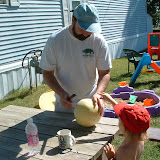
Donald went shopping at Woodman's and brought home the most fantastic melon! I think it was a honeydew. It was so, so sweet. Ulysses kept calling it a "pumpkin."
 |
| 2007_07 Melon |
Click for more pix and a little movie. Don and U and I devoured the melon outdoors, as a messy, juicy melon should be. Sweet, wonderful. Pet peeve: slicing and serving underripe melon. Melons on salad bars. Tasteless, tough. If they're sturdy enough to hold up to being on a salad bar, they're not good to eat. So just forget about putting them on a salad bar, already!
Tuesday, May 22, 2007
My rant against macrobiotics
 Macrobiotic Diet...thoughts Macrobiotic Diet...thoughts | ||
I'm posting it here, too, because I'm kinda psyched about finally writing out some of the things I've been kicking around in my head, and ranting about verbally, for so many years. The first part, in QUOTE tags, was posted by someone who was responding to another LCF member who had harsh criticism of macrobiotics.
...
While Nero's proposed eating plan may be considered macrobiotic, that doesn't mean he can't follow it's general guidelines with success...
...
I still believe it's a workable framework
.....
This is a reasonable point of view. But in this case the general guidelines aren't worth a hill of adzuki beans. Let's take a look at those guidelines and what they're based on.
The macrobiotic diet is a sublimated expression of a xenophobic, racist worldview. The food itself is modeled after an idealized version of monastic Zen dietary practices of the 19th century. Japan was forcibly opened to the West in the 1850s; macrobiotics, in my reading, is part of the inevitable cultural backlash, as it favors all things Japanese are pure and superior.
It was formulated, not by a doctor, scientist or traditional healer, but by a Japanese philosopher who fancied himself to be following in the footsteps of Kaibara Ekken, an influential 16th century neo-Confucianist naturalist and botanist.
As jem says, everything in macrobiotics is seen through the filter of yin and yang. Correct diet is a nurturing balance of polar opposites. Understanding how different foods have different qualities of yin and yang is the essence of the macrobiotic diet. In fact, diet is (supposedly) just a single aspect of macrobiotic practice. It's also about your physical activity, your emotional state, the climate where you live, the season, your relationships with others.
For instance, someone who does manual labor (yang) in Canada (yin, cold) would need a difference balance of yin and yang in their diet than someone who has a sedentary lifestyle (yin) in Florida (yang).
The foods that are available in a given place and time also fit into yin and yang. Fruit (yin) grows in the summer (yang). Tropical fruits (super yin) grow in the tropics (more yang than a temperate zone summer).
Since the world is so big, and the range of human activity is so great, and there are so many kinds of natural foods, you might expect a wide range of dietary possibilities. As long as you create a harmonious balance of yin and yang in daily life -- which includes diet -- you're practicing macrobiotics. Right? Wrong.
In practice, there is a very narrow range that is sanctioned as good, balanced eating. In fact, the word "wide" is commonly used in macrobiotic community parlance as a synonym for "bad"; correspondingly, "narrow" is used to mean "good."
At any rate, everyone's individual dietary balance of yin and yang, even when determined by a "macrobiotic consultant" who reads the lines on your face and shapes of your features to figure out what you should and shouldn't eat, comes out looking pretty much the same. Mostly grains, a lot of beans, a little fish, some pickle, seaweed, vegetables. By the way, the percentages are generally done by volume, not caloric contribution. 25% vegetable means that a quarter of your plate is covered in kale, for instance. Or, in winter, the same volume of butternut squash. (But not spinach -- spinach is bad. So are regular button mushrooms. Too yin. More on this sort of thing later.)
And, by astounding coincidence, it all just happens to consist of traditional Japanese food. The best grain for you: rice. Should you eat animal protein? Some fish is OK.
By another astounding coincidence, all of the foods that are bad for you come from Japan's traditional cultural enemies. Here are some of the foods that are overly yin: tomatoes, potatoes, red peppers. Corn is not so great, either. Notice what these have in common? All are "New World" crops, forced into Japan in the 19th century.
Garlic and red pepper are considered far too extreme for human consumption. Note that garlic and red pepper are an important part of the cuisine of Korea, which has long been looked down on as inferior by (the worst part of) Japanese culture.
Yet, wasabi (that superstrong Japanese horseradish) is good. Even though it's at least as "extreme" to eat as garlic and red pepper. Wasabi cleanses toxins. It's a powerful healing food. Ask why wasabi is good and red pepper is bad, and you get a complex answer about their individual yin/yang makeups. It's like this all through macrobiotics. The answer comes first, and the justification follows. And every single time, the bad thing is not part of Japanese tradition, but the good thing is. (New world beans and squashes are a notable exception -- although Japanese adzuki beans and Hokkaido pumpkins coincidentally happen to be the most healthful beans and squashes of all.)
Raw salads: Bad! Very yin! Rice? Good! Wheat? Better left out entirely. The worst way to eat wheat: as bread. Beef, milk, cheese: Terrible, the worst! They leads to all kinds of disease. Based on what? They're all way too yang. What makes them more yang then salty fish paste? Or pickled plums? Oh, by the way, all the bad things listed here are part of the European culinary tradition. What a coincidence!
The justifications for the macrobiotic guidelines are just incoherent. Brown rice turns out to be the perfect food for all humans, wherever they live, through every season. Even though one of the stated foundations of the diet is local and seasonal food, somehow rice manages to transcend these boundaries. In the U.S., rice grows in the southern states, like Carolina and California, but not in, say, New England. So why did the macrobiotic leaders in Boston live primarily on rice? Why did they counsel my spiritual community in Pennsylvania to base its diet around rice? I asked. The answer: because we're at the same approximate latitude as Japan, where rice grows well. So, I asked, people in southern Mexico would not base their diet around rice? Same with people in Iceland? The answer: they should eat mostly rice, too, because it creates the best yin/yang balance in the human body. But I thought we were balancing with our environment and physical activity level? The answer: Oh, yes, absolutely!
Cirtus fruits were verboten: too yin. I asked, how about people in Florida and California -- they can eat citrus, right? Answer: no, because it's an introduced crop in this continent. I asked: Like rice? Answer: well, here in the U.S., there are types of wild rice. Me: But they're botanically very different from the rice we're eating. Answer: But the yin/yang balance is very similar. So, the people who live where citrus comes from, can they eat citrus? Answer: very, very small amounts. It's very yin and extreme.
It's like a complicated equation that, no matter what you plug into the front, it always comes out the same on the other end.
So. Guidelines? You want guidelines? Macrobiotics has plenty of them. A "workable framework"? Sure, if you overlook the fact that it's not built around any of the nutritional understanding that we take for granted on these boards. If you're looking for guidelines that make any sense, you could do far better elsewhere. You might check out Sally Fallon's Nourishing Traditions, for instance, if what appeals to you is whole foods including whole grains, with an introduction to many nearly forgotten, but eons-old, preparations.
Is there anything good to be gained from looking into macrobiotics? Actually, yes. Many of the dishes and cooking techniques are really quite excellent. Many of the ingredients open up a lot of culinary possibilities. Also, macrobiotic followers have kept alive many traditional Japanese food products that, in mainstream Japan, have been replaced by artificial analogs.
For example, tamari and miso. I never seen good ones in Asian groceries, and I've been looking for decades. It's sad, but all you can find there is caramel-colored or quick-aged soy derivates, often with artificial flavorings. But at the natural foods store or aisle, you can find the real thing, aged for months or years, according to traditional methods.
Another wonderful thing to learn from a macro book or cooking class: a wide variety of vegetable cutting techniques and preparations. There are so many cutting shapes, and each has its own name. It's very Japanese, in a beautiful way. It's one of those intricate, precise cultural arts, like origami, sushi or flower arranging.
Nero, I hope some of this is helpful. In your first post, you presented a description of macrobiotics. Did you write that, or where did that come from?
Tuesday, April 18, 2006
Leave them to it
The weather has been beautiful for about a week now, climbing sometimes even into the low 70s. That means taking Ulysses to the playgrounds and parks for the first time since last fall, and it means more opportunities to see adults interacting with their children and grandchildren.
And once again, nearly every encounter makes me cringe.
Am I just judgmental, and a kook? Am I so far outside the mainstream in my thinking? Or is there some validity to my point of view?
It feels like what I'm hoping for is so basic, something that should be the norm rather than the hoped-for exception: big people letting their little ones be themselves. Not attempting at every moment to bend them to some purpose. Meeting them where they are, rather than steadily working to bring them somewhere else.
I've even come to dread when grown-ups arrive with their kids at the playground, because the time from their arrival to the first thing that ties me in knots inside is, inevitably, so blasted short.
I went to the Northland playground last week with U after work. There were three people there, two women -- perhaps they were a mother and her grown daughter -- and a little girl (who, it turned out, was born two days after U). The girl (dressed in regulation little-girl-pink shoes, frilled jeans, and a striped shirt whose colors included pink) went up on the gym again and again, sometimes going down the spiral slide and sometimes down one of the twin straight slides.
The women never went up on the gym once -- I've come to expect that. They stood on the ground offering a torrent of coaching, cajoling, instruction, correction.
"Go up the steps! Keep going! OK, now go down! Down! Go down now! Go down the slide! No, the other one! Well, OK, you can go down that one. Put your feet out in front of you. No, not like that! Out in front. Wait, stop! That's right." Not for an instant, when she was on the equipment, did she get space to explore and be, just be. To think about what she liked and didn't like up there, to decide where she wanted to turn. Of course, she did ultimately decide which way to turn, but the currents in and against which she swam were strong. And loud! As she grows, as she's better able she to understand what her big people are saying, the current will only swell.
Every time the kid got to the top of a slide, the exhortations to put her feet out in front of her came in a steady hail. Sure enough, I noticed, she truly didn't sit down properly at first, but she would kneel or otherwise seat herself so that her legs would be all a-tangle if she were to start sliding that way.
Ulysses got atop the straight slide, and he stood at the top, starting his slide from there. He tumbled! Because of the super-duper safety design, though, he was safe. But I was chagrined. The little girl's mother, who stayed on the ground near the top of the slide, caught him and helped straighten out his postion, so that he slid comfortably the rest of the way down. Maybe there was something to this direction thing.
The second time U used the slide, he tumbled again, trying to start his slide from a standing start in the same way as before. The girl's mother was elsewhere, and I didn't catch him, either. He bumped onto his bottom roughly on his way down. Oops. So that's why they keep telling that girl how to sit, I thought. It seemed like a good idea just then.
The third time, Ulysses seated himself carefully at the top of the slide, his feet straight out in front of him. From then on, no tangled feet -- that day or since, come to think of it.
My point, in case it doesn't speak loudly enough for itself:
Repeatedly being told where you should put your feet in order to slide the way you're told to slide
is not as good as
Having the opportunity to find out where you want to put your feet in order to slide the way you want to slide.
OK.
Later on, a young, slim, fashionable woman showed up with a one-year-old (my est.) and a big dog. Tying the dog to the stroller and taking out the kid, she tells him, "Now be careful and don't get dirty, because you've already had your bath. Stay clean! You've had your bath already, so don't get dirty." All right now, be sure to stay clean!" Repetition and all.
I couldn't keep quiet through all that. I laughed good-naturedly and said, "Good luck with that." She smiled, too. Success -- I made friendly contact with one of the big people!
I was trying not to be disingenuous, to really be coming from that I'm-on-your-side kidding place. Trying.
But my inclination was to have said, instead, "What a heavy trip to lay on that kid! Either forget about the bath and let him be himself at the playground, or else don't come to the park! What did you give him a bath for, anyway? You put those two things together that don't go together -- bath and trip to playground. If it doesn't work, it's your doing, not his."
The baby, just learning to walk, climbed the steps, eager and happy. So eager, he reached a foot way over to a higher step, and then couldn't progress right away, because his legs were spread so far apart.
I remember U working out that sort of thing last summer. Struggling, sometimes rooted to one spot for many seconds before dropping to his knees, or inching his feet to where they needed to be, or grabbing a handrail, or taking my hand for extra balance, or whatever other solution he devised. Sometimes he would finally turn to me, reaching up with a hand, signaling he wanted help, his face sometimes tilting up to me, but more often still pointed, intent, toward his goal. I would give help instantly, meting out the level of assistance I thought he wanted, careful not to overstep my invitation.
"If you put this foot here closer to the step, you'll be able to go up easier. Here, move it closer. Like this, look. Move it closer -- ergh." The woman was hovering close above her baby, moving his feet for him. The baby was struggling against it.
What's going on? Are Americans so determined to get to the top of the stairs that they can't imagine any instance where the process of climbing the stairs trumps getting to the top of the stairs?
The kid is going to learn how to walk. He's going to climb stairs. What's the hurry? Is it so difficult to see -- anyone can climb stairs. The same cannot be said of problem solving.
It doesn't seem like such a big deal to us, climbing stairs. I think that's because we don't remember learning to do it. It is a big deal. And when each stair comes up to about your kneecap -- that would be a big deal even for you, even today. (That's what I tell people who comment on what a fuss U seems to be making, huffing and puffing and grunting gleefully, while he's hauling himself up the five flights of stairs from the lower level to the lobby of the Princeton Club where we go swimming on Saturday mornings.)
Learning to do it yourself, figuring out the nuances that make it work and not work. Realizing that when your lower foot is closer to the step, you can pull yourself up that step more easily. Piecing together the principles of physics that are at play. This is something that noone can give a child. It is something the child desperately wants. And all the big person has to do is this: leave them to it.
That's the phrase I've been casting about for. What I keep hoping against hope to find, and being dismayed over and over again when I don't: adults who respect what little kids are up to, and are willing -- are bold enough -- to leave them to it.
Wednesday, February 8, 2006
Can't go wrong with monkeys
"We'll have storytelling, then we'll watch a movie, and then we'll do a craft," said the woman who was leading the program. She had short gray hair and wore slacks and a long, lightweight jacket that swung down to mid-thigh. I hoped desperately that she would turn out to be cool.
U and I were at preschool story time at the Lakeview branch of the public library, in our neighborhood. It began at 7 p.m., so I scooped him up when I came home from work, pulled some clothes on him, and we went on our way.
The program was held in the magazine reading room, a pleasant carpeted space with cozy leather(ette?) armchairs and a fireplace.
"We'll start with our names. What's your name?" she said, addressing the child farthest to her left.
"Jake," he said.
"What letter does that begin with?"
"J," he answered.
"That's right!" she said. She wrote a big "J" on her chalkboard and she launched briskly into a song that clearly was meant to be adapted, verse by verse, for each little audience member: "J for Jake, my name is Jake, my name is Jake, what's your name?" or similar lines, the idea being that the next kid over says, "Chloe," or whatever, and the storytelling lady says, "What letter does that begin with?"
Midway across the room, a boy of perhaps three, surely not much more than four, kneeled on the floor in front of the chairs where his parents sat. "Ike!" he said, happy that his turn had finally arrived.
"What letter does that begin with?" asked the storyteller.
His little body shot up in its kneeling position, so vigorously that his knees hardly were able to anchor him to the carpet. "K!" he announced. He was eager for this moment.
"'K,'" repeated the woman, slowly. Dubiously. She didn't write it on her chalkboard. "Well, it does have a K in it." She tilted her head to one side. "But does it begin with a K?" She waited for an answer.
The boy looked like he wanted to respond, but no longer knew what to say. Obviously the answer the grown-up wanted was, “No."
"What letter does it begin with?" she persisted. Ike sank back on his heels, without a sound.
"How about I? Does it begin with an I?"
He mumbled assent.
"All right!" said the storyteller, with lavish approval. "I!" She wrote an I on her chalkboard and continued the song. I saw Ike looking out into the center of the room, while the other children turned their gaze to the next child.
I was confused, and angry. What was the big deal? Why did she have to make that kid wrong? In public? In a room full of strangers? Why was it so important to teach the kid about how spelling works -- like he's not going to learn how to spell his own first name, for pete's sake -- that is the first thing a kid learns anyway -- at the expense of his pride and enthusiasm?
Why not sing "K for Ike"? It seems to me that K is the most distinctive sound in "Ike," even if it isn't the first letter. The song didn't say, by the way, "The first letter of my name is __." It just said "C for Cassady," or whatever. Why can't K be for Ike, for a few seconds? How about, "Ike! That has a great big K right in the middle of it!"
She went on to read us some stories from picture-laden books, stories featuring monkeys. By the middle of the second story, the children weren't paying attention much. It was clear to me that the plot was far too complex for them to grasp, and the pictures were not all that engaging. The book was small and fairly far away, too. "Are you listening to the story?" she asked, a little sternly, when the sound of children shifting positions and talking took over. Her admonition didn't make any difference to what was happening in the room. She pressed on through to the end of the book.
Next came an animation based on the picture book, "Goodnight, Gorilla." Lovely pictures, a haunting jazz soundtrack that riffed on Brahms' Lullaby.
Then the lights came back up and it was craft time.
Tables were prepped with craft sets for each tyke. Each place was set with a coloring sheet with an illustration of a monkey, small, colorful feathers, coin-sized leatherette ovals, stars, circles and other shapes. Plastic soup bowls, each containing several glue sticks, were placed in the center of each table.
The idea, we were told, was to make a hat for the monkey out of the leatherette shapes, then decorate it with the feathers.
The parents jumped in with enthusiasm. At my table, a man and woman guided a three(?)-year-old’s hands so that in no time his monkey sported an artful befeathered, multi-leatherette-shape beret.
The boy was delighted with the feathers. “Fe-fah!” he said.
“This is glue,” said the mother, working the glue stick to fix another feather on the monkey’s hat. “Can you say ‘glue’?”
“Fe-fah.” said the boy, passing a feather between his fingers.
“Glue,” she insisted, waving the glue stick toward him. "Glue."
Meantime, Ulysses scraped at the tip of the glue stick with a fingernail. A blob of purple glue stuck to it. He shook his finger, then rubbed it against the paper. He explored the blob’s texture with his finger. I stuck a feather into it to demonstrate that it would stick to the paper. But he was already playing with his leatherettes, pouring them from one palm to the other. He saw the leatherettes at the empty place settings at our table, and went round to collect those, as well. He took a bunch of feathers and placed them on the concave seat of his molded plastic chair. He examined them with his eyes and fingers, then went back to examining the leatherettes.
I marvelled at what I saw in the room: a lot of adults working very hard to make a group activity happen against considerable odds. The children were clearly – to me – continuously and spontaneously becoming immersed in their own deep worlds of experience and exploration. But their grown-ups consistently, automatically, pulled them out. They were committed, it seemed, to compelling the children to attend only to a specific set of pre-selected, narrowly defined, details and procedures.
What kind of learning was supposed to be going on?: How to use a glue stick? How to follow instructions? How to complete someone else’s pre-prepped creative vision? How to pick up an object and fasten it where it was supposed to go? Or maybe it was the very concept of “supposed to” that was being taught.
As far as I could tell, U was the only kid learning anything about leatherettes, shapes, colors and feathers. Or at least the only kid not being so strictly channeled.
By now the craft time was over. Families were leaving, and the activity leader was giving each child a box of conversation hearts -- Valentine's Day was near -- on his or her way out the door.
I heard a man say to his child, “Look, Michael! You get candy for doing the project!”
U and I lingered longest. He continued to play with the shapes and feathers, and I gathered up materials and straightened up, as the room emptied. The woman asked if I wanted some candies for him. I thanked her, but said that since he hadn’t noticed them, we might as well not point them out. I asked if we might keep a few leatherette shapes. She hesitated, then said, “Sure, why not?”
The hesitation was interesting, I thought, for a couple of reasons. First, we had already declined the candy. Hospitality would seem to demand that a host would be glad to have discovered an alternate gift.
Second, suppose we had glued those same leatherette shapes to our coloring sheet. I wouldn't even have thought to ask about taking them with us. All the other kids and parents had taken theirs along. I thought of Locke's theory of the origin of property rights. You mix your labor with a natural resource that belongs to noone -- for instance, you chop and saw a log and make a trunk from it -- and it thereby becomes your property. Ulysses hadn't made the monkey hat with his leatherettes. Not only that, his parent hadn't done her share, either. Hadn't kept her child in his seat while she hovered and got the monkey cap made, one way or another. We didn't "do the project."
Perhaps offering the candy was an attempt at a good deed on the part of the storyteller -- a charitable gesture. But when I asked for the craft supplies -- without putting any work into them -- I had gone too far. Plus, unlike the candies, the shapes hadn't been offered; I had cast myself as a supplicant.
I heard some folks thank her for the session, saying that the theme was a good one.
She laughed. “You can’t go wrong with monkeys!”
The original post/article was by Tara Parker-Pope and titled "Are Kids Getting Too Much Praise?" The URL and article text follows below. The premise of the article intrigued me, but I thought the article itself was put together in a slipshod way. Many of the readers' comments nicely expose various logical gaps.
The examples of good praise vs. bad, for example, I think are all examples of bad praise -- they don't get specific enough with their specificity. More useful than "You did great on your math test," for example, might be, "I notice that you can see how little parts fit into a big pattern," or "Practicing all those addition problems over and over really paid off when you took your math test."
I also like the idea that I got from -- I think it was the book "Easy to Love, Difficult to Discipline," which is a horribly uncatchy title, although it makes sense when you parse it. That author suggests asking a child what they think of a particular accomplishment or creation, rather than automatically jumping in with a compliment. This is especially true, I think, when the topic at hand is something the child might have some uncertainty about. Tuning in to see what sort of emotional guidance the child needs is, I think, better than assuming that cheerleading is always the answer.
For instance, "How do you feel about that math test?" might be a useful conversation opener. Even if the grade was perfect, the answer might be, "I wish I'd studied harder," or "It was too easy -- it didn't feel like I even did anything." Imposing a positive statement like "You did great on that math test!" at the outset might shut out the possibility of real conversation.
Then there's the comparison made between the Korean vs. American kids. The study that the NYT and Scholastic articles describe didn't measure how much praise the children were given. It measured how good the children thought their math skills were, and how good their math skills actually were.
Even if it turned out there was a difference in praise given the two groups, the difference in achievement could result from any number of other factors. So might the difference in how the children describe their skill levels.
Some readers commented that the Korean culture values humility while ours encourages statements of self-confidence. In any case, the fact that few Korean students say they excel at math tells us little.
Here's that NYTimes article:
http://well.blogs.nytimes.com/2007/10/29/are-kids-getting-too-much-praise/